2025 AIChE Annual Meeting
(233b) Affinity Membranes Containing Complexing Agents for Li+/Mg2+ Separation
Authors
Jada Mowatt - Presenter, University at Buffalo, The State University of New York (SUNY)
Haiqing Lin, University of Buffalo, State University of New Yor
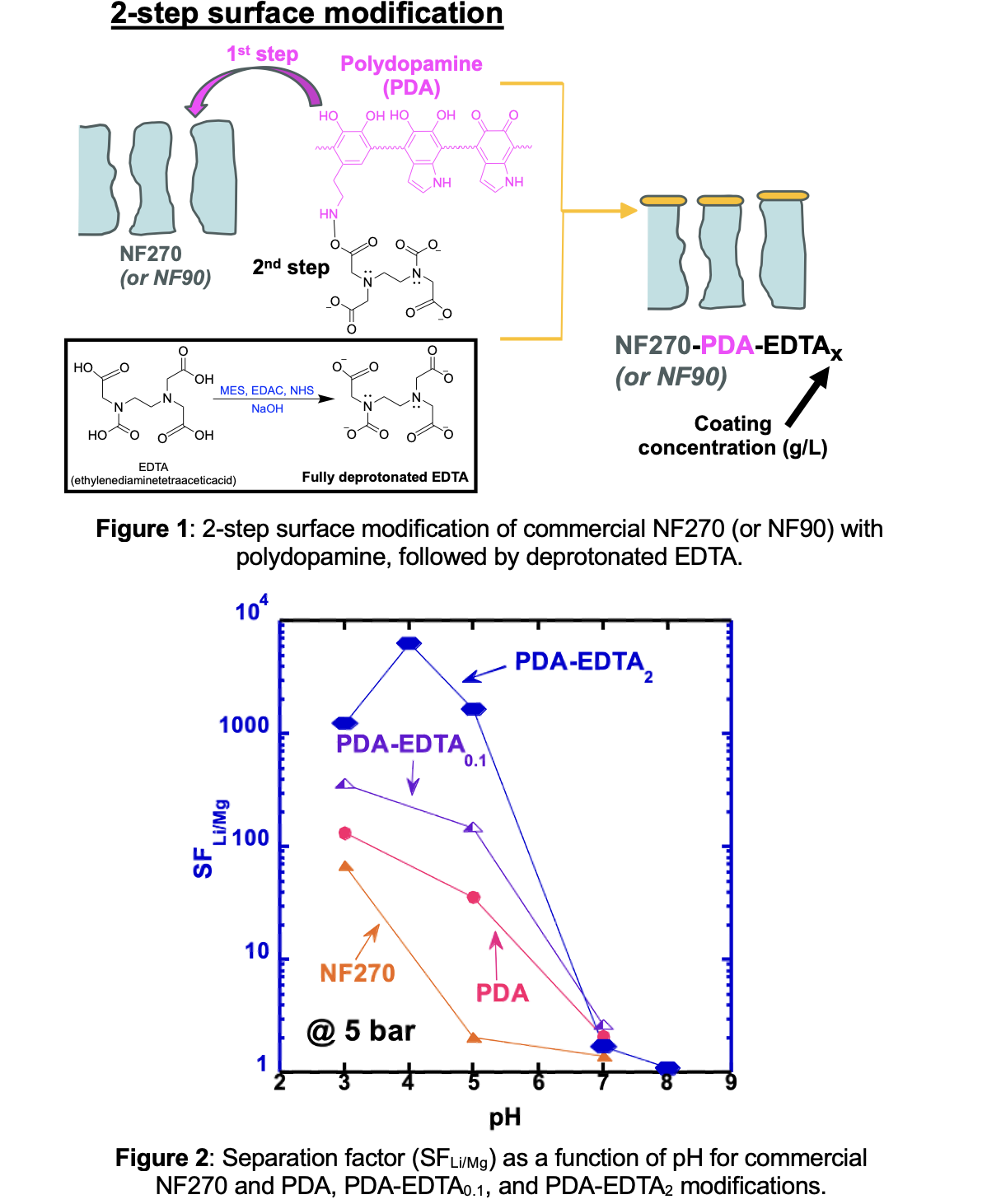
Lithium (Li) is a highly desired element for clean technology, and its production from brine often involves the separation of lithium chloride (LiCl) from its mixtures with magnesium chloride (MgCl2). Nanofiltration (NF) membranes present an exciting alternative to extract lithium, being cost-effective, energy-efficient, and environmentally friendly. However, there is a tradeoff between Li+ permeance and Li+/Mg2+ separation factor (SF); high permeance is typically faced with a low separation factor and vice versa. Herein, we demonstrate that NF membranes can be surface-modified with chelating agents, such as ethylenediaminetetraacetic acid (EDTA), to achieve superior Li+/ Mg2+ SF, by forming strong complexes with divalent Mg2+ and reducing its diffusivity, as opposed to monovalent Li+. Specifically, commercial NF270 and NF90 were first primed using bio-adhesive dopamine, followed by EDTA grafting via its reaction with polydopamine (PDA). The membrane surfaces were characterized using water contact angle (WCA), scanning electron microscopy (SEM), atomic force microscopy (AFM), X-ray Photoelectron Spectroscopy (XPS), and zeta potential. The effects of EDTA concentration, pressure, and feed solution pH on Li+/ Mg2+ separation properties were thoroughly investigated. The EDTA grafting increases the Li+/ Mg2+ SF. For example, the modification using 2 g/L EDTA slightly increases the Mg2+ rejection from 99.12% to 99.99% for NF270, but dramatically increases the Li+/ Mg2+ SF from 68 to 1260 at pH 3. Additionally, decreased WCA was exhibited for EDTA-modified membranes. Both single salt and mixed salt tests were completed and displayed consistent trends. The performance of NF90 was also compared with that of NF270. Overall, this study unveils the potential of harnessing the affinity with ions to improve the membrane separation properties.