2025 AIChE Annual Meeting
(141d) Advancing Volatile Fatty Acid Accumulation in Seaweed-Arrested Anaerobic Digestion through Complete-Set Parameter Monitoring and Metagenomic Dynamics
Authors
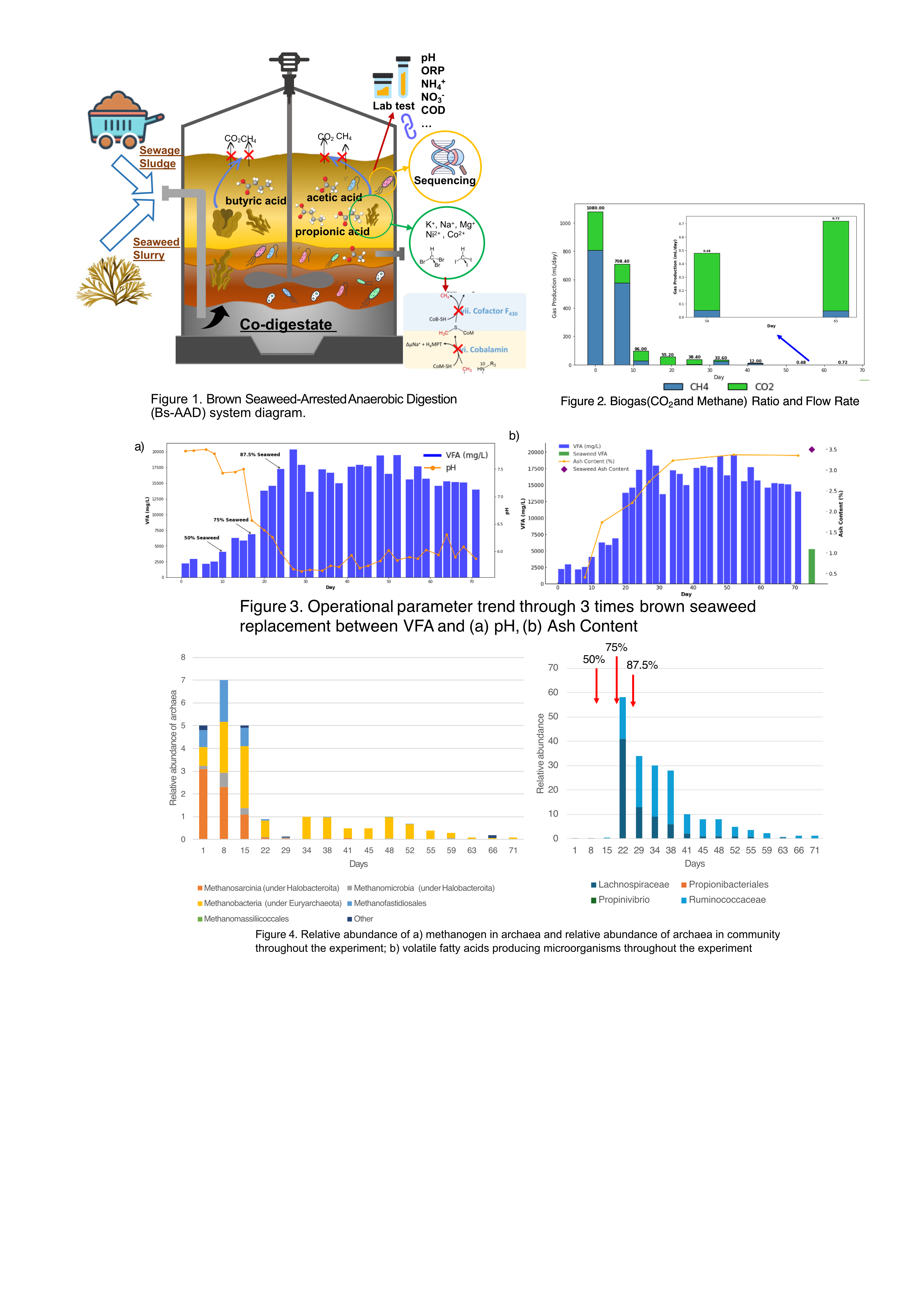
Seaweeds (macroalgae), especially brown seaweed (sugar kelp) are a good feedstock for AAD, since they have larger share of global cultivation and are non-food-grade biomass. In addition, seaweeds possess high salinity and bioactive compounds (e.g., halogenated methane analogues (e.g., bromoform, iodoform), polyphenols, and trace metals (nickel, cobalt)), which suppress methanogenic archaea and inhibit methane production. However, there are several critical knowledge gaps impeding real-world applications of brown seaweed-AAD (Bs-AAD) and VFA accumulation, such as the biochemical mechanisms and microbial pathways for suppressing methane production, the changes in key operational parameters, and the microbial and process dynamics during the transition from AD to Bs-AAD.
This study presents a comprehensive experimental investigation and a robust conceptual framework for implementing Bs-AAD as a sustainable and economically favorable technology for VFA production from organic wastes. The objective of this study is to define reliable control parameters, evaluate seaweed’s inhibitory role, and lay the groundwork for scalable Bs-AAD applications in waste-to-chemical systems. We hypothesized that selectively inhibiting methanogenic archaea using brown seaweeds could facilitate the proliferation of acidogenic bacteria and enhancing VFAs yields. A lab-scale Bs-AAD system (volume: 2 L) was operated at 35 °C using digestate obtained from a municipal wastewater treatment plant. To systematically induce the metabolic transition from methanogenesis to acidogenesis, brown seaweed slurry (Saccharina latissima) was incrementally added through three sequential replacements on Days 7, 14, and 21 during the 70-day operational period. An extensive monitoring protocol was employed, with frequent sampling (three times per week) to analyze critical biochemical and engineering parameters, including pH, oxidation-reduction potential (ORP), electrical conductivity, ammonium (NH₄⁺), alkalinity, chemical oxygen demand (COD), and VFA constituents. Concurrently, metagenomic dynamics were thoroughly examined using 16S rRNA gene sequencing to trace the microbial community change. This integrated design represents a methodological advancement in connecting biochemical, microbial, and key process engineering indicators to guide the establishment and progression of the Bs-AAD process and methanogenesis-to-acidogenesis transition. Furthermore, microbial analyses were performed to identify crucial microbial shifts and adaptive mechanisms occurring during this metabolic transition, offering unprecedented insights into the microbial ecology of Bs-AAD systems.
The 70-day test clearly indicates that the introduction of brown seaweeds induced a rapid and substantial accumulation of VFAs and exhibited the effectiveness of the arrested digestion strategy. VFAs concentrations peaked at approximately 20,350 mg/L—an eight-fold increase from the ~2,500 mg/L observed under conventional AD conditions—and remained within the high range reported for AAD systems (10,000–20,000 mg/L). The total organic carbon conversion efficiency to VFAs increased markedly from ~18% in traditional AD to 66.18% in the Bs-AAD system, capturing nearly two-thirds of the input carbon in a chemically valuable form. Simultaneously, pH dropped from ~7.6 to 5.6, providing a straightforward and sensitive indicator of acidification driven by VFAs buildup and the onset of metabolic arrest. Biogas—particularly methane—production declined sharply, with total gas flow falling by over 90% within two weeks of the first seaweed addition and stabilizing at near-zero levels (~0.5 mL/day) in the rest of the test period, confirming a near-complete suppression of methanogenic activity. The salinity, which indicated by inorganic ash content, rises from 0.41% to 3.23% further reinforced this transition, serving both as a proxy for salinity stress and a mechanism of methanogen inhibition. Elevated ash content induced osmotic stress that disrupted microbial membrane integrity, selectively suppressing salt-sensitive methanogenic archaea. In parallel, seaweed-derived bioactive compounds—such as bromoform—likely contributed to enzymatic inhibition within the methanogenesis pathway. Metagenomic sequencing confirmed a dramatic restructuring of the microbial community, with near-complete elimination of methanogens and a dominance of VFA-producing bacteria such as Clostridium. Together, the elevated VFAs yields, significant pH reduction, increased ash content, and sharp suppression of gas production highlight a redirection of system metabolism and reactor ecology. These findings validate the Bs-AAD system's potential for controlled, high-efficiency fermentation via integrated biochemical and engineering optimization.
Beyond biochemical performance, the Bs-AAD system demonstrated remarkable gains in energy recovery and resource valorization. By arresting methanogenesis, the system retained a substantially greater portion of the substrate’s energy in liquid-phase VFAs, achieving an energy yield of approximately 325.6 MJ per m³ of digestate—about six times higher than the energy typically recovered as methane in conventional AD. This shift not only improves energy capture efficiency but also positions VFAs as more flexible and higher-value intermediates for downstream processing. From an economic perspective, this represents a transformative waste-to-value paradigm: while methane is valued at roughly $0.30 per m³, VFAs can command $6–16 per m³ depending on purity and application. This twenty-fold increase in product value underscores the economic advantage of Bs-AAD system. Furthermore, the process utilizes feedstocks such as wastewater sludge and seaweeds—both low-cost or waste materials—supporting scalability and integration into existing WRRFs infrastructure. These findings reinforce the role of Bs-AAD in advancing circular bioeconomy initiatives by converting low-value waste streams into profitable, sustainable chemical products.
This study provides compelling evidence that Bs-AAD is a technically viable and promising alternative to conventional AD. The novel integration of real-time monitoring with metagenomic profiling allowed for a systems-level understanding of how operational, chemical, and microbial variables interact to govern the transition from methanogenesis to acidogenesis. This unified view is critical for developing precise control strategies and scaling up Bs-AAD to full-scale waste treatment applications. Most significantly, this work advances the field of anaerobic bioprocessing by demonstrating how metabolic redirection can be engineered through substrate manipulation and environmental control. For the AIChE community, these findings represent a major contribution to the field of “Waste Feedstocks to Fuels and Petrochemical”. As global industries seek resilient and efficient waste-to-resource technologies, Bs-AAD sets the stage for the next generation of low-emission, high-value bioconversion systems—bridging microbial ecology with real-world engineering practice.