2025 AIChE Annual Meeting
(3iz) Advancing Electrolyte Design for Electrochemical Energy Storage and Conversion
Author
Research Interests:
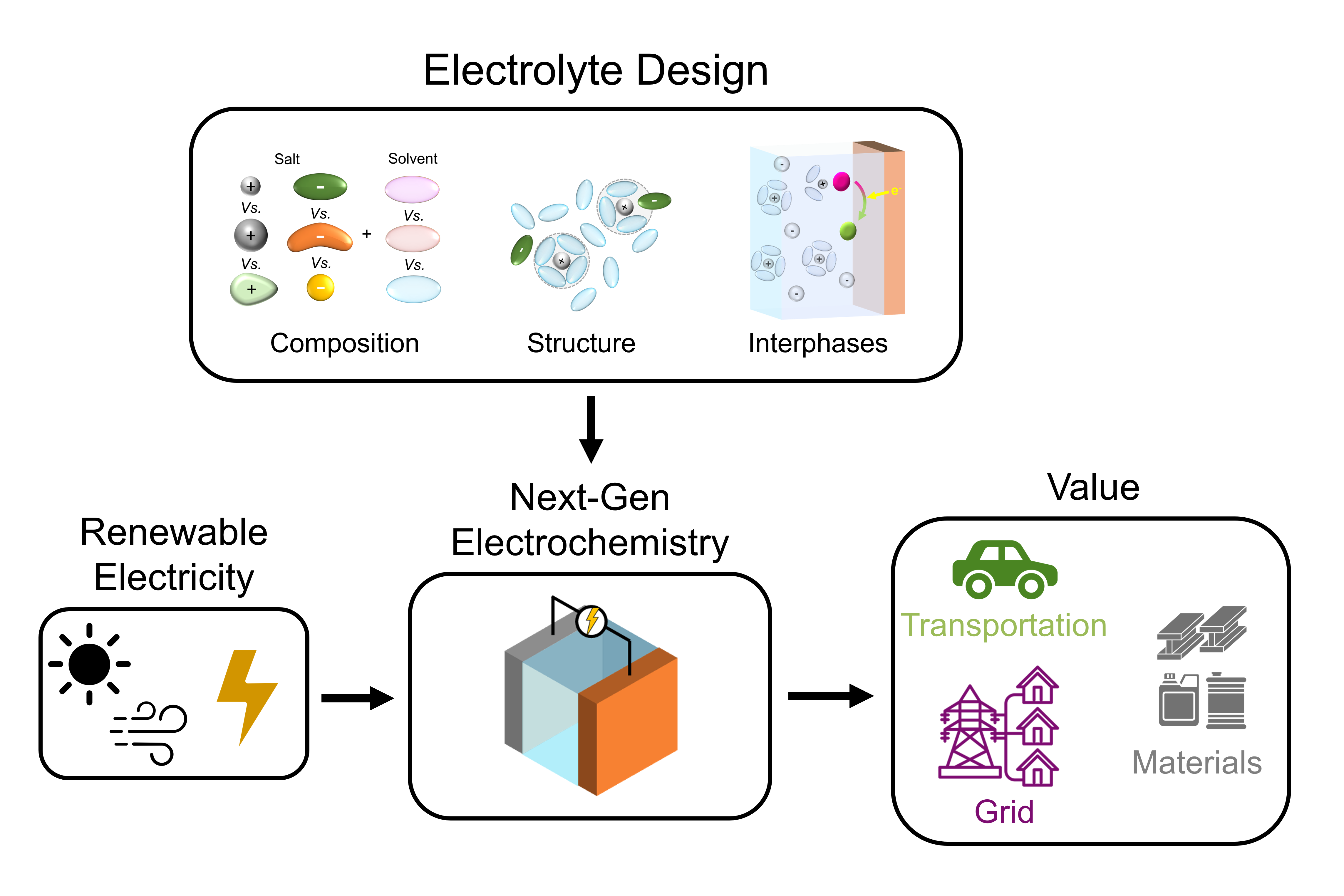
I am principally interested in understanding and designing liquid-phase phenomena to develop next generation energy storage and electro-synthesis technologies. Our previous work involved the development of electrolytes to enhance the performance and operating range of high-energy lithium batteries, low-cost zinc batteries, and CO2 electrolyzers.
Moving forward, I intend to direct my efforts towards developing low-cost battery chemistries to support the grid, and new electrolyzers for the sustainable production of steel from iron ore. The success of these technologies relies on resolving (electro)chemical instabilities between their liquid electrolytes, solid electrodes, and polymeric membranes. These instabilities must be first better understood before new solutions can be devised. My future work aims to do so with electrolyte design, through both experimental and computational approaches. Specifically, we will examine the impacts of chemical composition, and ionic structure in the bulk fluid and at interfaces to improve performance. The hybrid experimental and computational approach will enable efficient testing and rapid iteration, facilitating the fundamentally guided design of next-generation systems.
Teaching Interests:
The purpose of higher education is to provide a platform for students, regardless of their background and starting point, to grow and make meaningful contributions to their communities and society at large. I am especially interested in teaching courses centered on electrochemistry and chemical engineering, with a focus on emerging energy technologies. Understanding these technologies involves weaving together concepts from multiple disciplines, including chemistry and materials science, to address challenges in energy storage, conversion, and sustainability. I therefore strongly value interdisciplinary approaches that blend materials chemistry and system design. In my classes, I hope to use flipped classrooms and project-based learning, as these methods best cultivate problem-solving skills and encourage collaboration, communication, and creativity. Ultimately, my goal is to contribute to a department and curriculum that prioritizes student flourishing and produces cohorts of thoughtful, motivated professionals.