2025 AIChE Annual Meeting
(400z) Advances in Gas Chromatography for Effective Analysis of Complex Refrigerant Blends
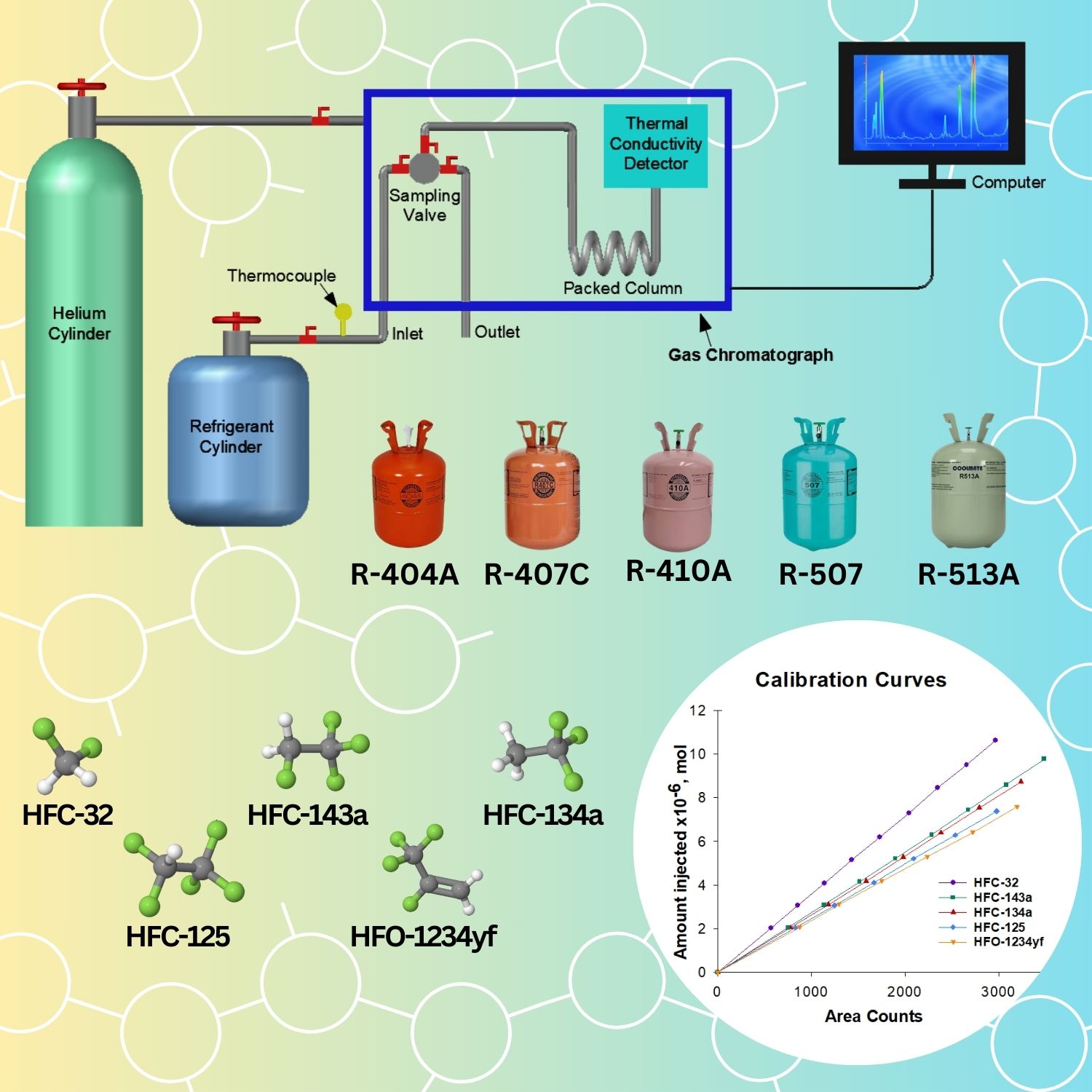
Hydrofluorocarbon (HFC) regulations have prompted the development of technology such as extractive distillation using ionic liquids to reclaim and separate HFC-based refrigerant blends. High purities of 99.5% by weight are needed to recycle single-component HFCs with low Global Warming Potential (GWP) and to provide the phased-out HFCs as future feedstocks for chemical transformation. This technology requires accurate and efficient analytical methods to quantify the recovered refrigerants’ purity. The present study uses two stationary phases (i.e., HayeSep D and Carbopack B) for comparison of gas chromatography (GC) analysis of multicomponent refrigerant mixtures R-404A, R-407C, R-410A, R-507, and R-513A. Using a commercial GC with a thermal conductivity detector (TCD) and a sampling injection valve, single refrigerant components HFC-32, HFC-125, HFC-134a, HFC-143a, and HFO-1234yf were analyzed for preparing precise calibration curves. The effect of GC parameters such as oven temperature, carrier gas pressure, and sample volume on peak separation and retention times was investigated. The HayeSep D method shows superior results to traditional methods (Carbopack B), with shorter analysis time, lower GC operating temperatures, less expensive supplies (e.g., GC column), maximum standard deviations <0.64% by weight, and 95% confidence level error of ±0.08 to ±0.8 wt% for all refrigerant mixtures. The following study provides additional analytical options for the refrigerant manufacturing and reclamation industry.