2025 AIChE Annual Meeting
(383aa) Advanced Reactor Modeling and Optimization for Novel Hydrocarbon Conversions
Author
Reactor/Reaction Engineering, Catalysis, Electrification and Decarbonization, Hydrocarbon Conversion, Hydrogen Economy, Process Development, Scale Up
Project Overview
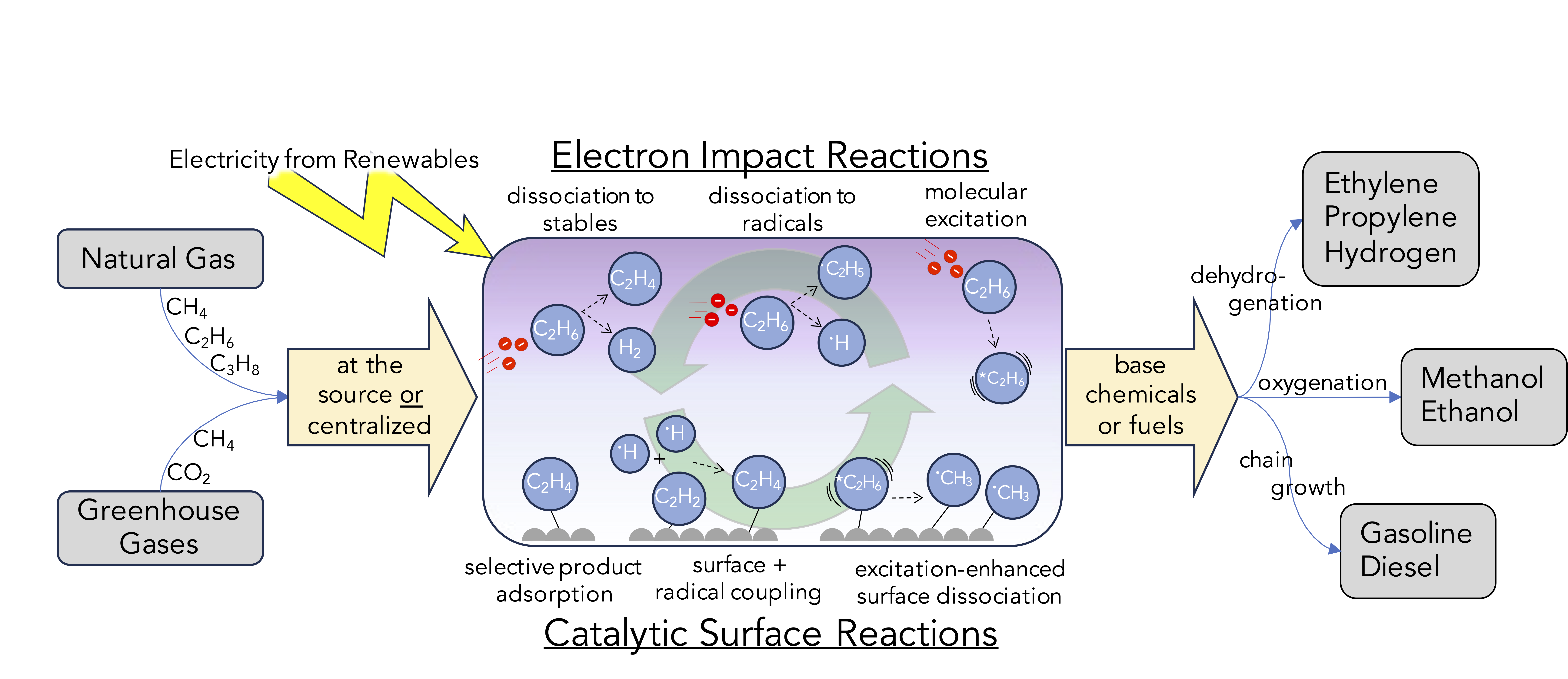
This project uses advanced reactor modeling to investigate nonthermal-plasma (NTP) driven ethane dehydrogenation (EDH). The primary outcomes of this project include fundamental insights about NTP-driven hydrocarbon chemistry, but the project can contribute reaction insights that translate to deployable applications of NTP technology. NTP enables various alkane reactions, including dehydrogenation, oligomerization, and dehydroaromatization. We focus on EDH due to its significant role in natural gas processing (40+ MTA in the U.S.) and because it is a primary process in ethane plasma, providing a rich source of fundamental insights. We developed kinetic modeling and reaction engineering frameworks to analyze ethane chemistry in NTP, identifying ways to enhance EDH performance and providing insights into reactor behavior. We used numerical optimization and machine learning (ML) of reactor models to explore optimal reactor conditions in coordination with experimental collaboration. We also employed thermodynamic analyses that attempt to describe non-equilibrium behavior. Additionally, our models can be extended to include heterogeneous catalysis in synergy with the plasma chemistry.
Project Intellectual Merit
Plasma catalysis for hydrocarbons is an expanding field, with most research focused on methane and oxidative reforming (often with CO2). Our project fills a gap by exploring NTP applied to ethane in non-oxidative settings, offering fundamental insights for application of NTP to both EDH and other hydrocarbon chemistries. This project also expands the field’s capabilities to apply traditional reaction engineering approaches to plasma-catalysis systems. Our application of ML to NTP chemistry drives novel insights and boundaries to the known chemistry of NTP EDH. Furthermore, we are developing discovery-focused models that explore fundamental limits of NTP ethane processing, promoting creative engineering solutions to those limits.
Project Industrial Relevance
The chemicals industry is transitioning from fossil-fuel-powered processes to electrified methods powered by sustainable sources like solar, wind, and nuclear. This shift aims to reduce or eliminate the massive carbon footprint of essential chemical production. NTP catalysis is an enabling technology for process electrification. Our research supports this transition by providing fundamental insights into NTP applications for EDH and other industrial-relevant chemistries.