2025 AIChE Annual Meeting
(37g) Advanced Gas Thermal Hydraulics Assessment in a Horizontal Dual Channel Facility Mimicking Prismatic Micronuclear Reactor Core Under Loss of Flow Accidents
Authors
Ahmed Jasim - Presenter, Missouri University of Science and Technology
Mahmoud M. Taha, Missouri University of Science and Technology
Muthanna Al-Dahhan, Missouri University of Science and Technology
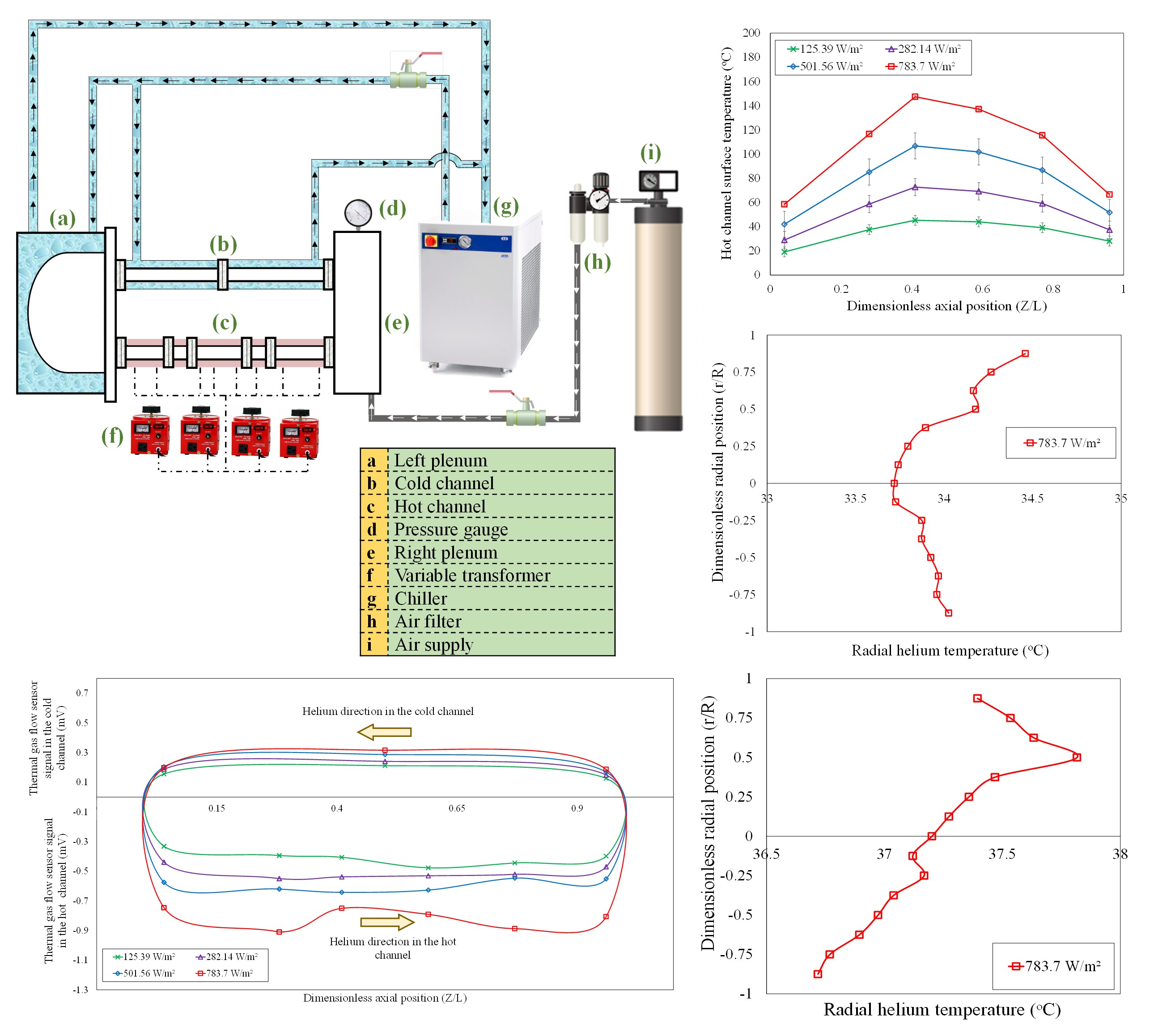
The development of horizontally oriented prismatic micronuclear reactors is advancing, with deployment expected within the next decade. Prismatic micronuclear reactors are a compact design for the fourth generation (Gen IV) gas cooled prismatic nuclear reactors but in a horizontal orientation. These plug-and-play reactors are featured to be easily transportable to remote areas, resilient, non-carbon emitting, and require minimal maintenance. Interestingly, micronuclear reactors have an outstanding passive safety system that protects the reactor from melting down during normal operation and accident scenarios. Heat removal during normal operation is carried out by forced convection where heat is transferred from the reactor core to helium gas, but during accident scenarios, as loss of coolant flow, there is temperature differences between the channels within the reactor core and heat removal by the gas is mainly dependent on natural convection heat transfer. Understanding gas flow behavior during accident scenarios is essential to ensure reactor safety. To address this, a separate effect experiment using a horizontal dual channel plenum-to-plenum facility (P2PF) was designed and tested as a model of the reactor core. Advanced measurement techniques, including thermocouples, micro-foil sensors, and thermal gas flow sensors, were employed to capture helium gas thermal hydraulics parameters. These measurements included temperature profiles, heat transfer coefficients, and gas direction under varying heating intensities. The results provided critical insights into gas flow behavior in the P2PF. Thus, the radial helium temperature distribution at the hot channel inlet is reasonably well-mixed around the channel centerline, with hot helium layers near the channel walls and cold helium layers near the channel center. However, an asymmetric radial helium temperature profile develops as helium passes through the hot channel until exiting the channel. This variation in helium radial temperature profile along the hot channel is explained by local buoyancy effects. Additionally, flow reversal and turbulence are found at the channel exit which in turn enhances heat transfer. Furthermore, predictive models for the axial average Nusselt number were also developed and tested. These findings offer valuable benchmarking data for validating computational fluid dynamics (CFD) simulations and heat transfer calculations. The study underscores the importance of further research into gas thermal hydraulics in horizontally oriented prismatic micronuclear reactors to support their safe operation.