2025 AIChE Annual Meeting
(633a) Accelerating Electrochemical Discovery through Integrated High-Throughput Experimentation and Machine Learning
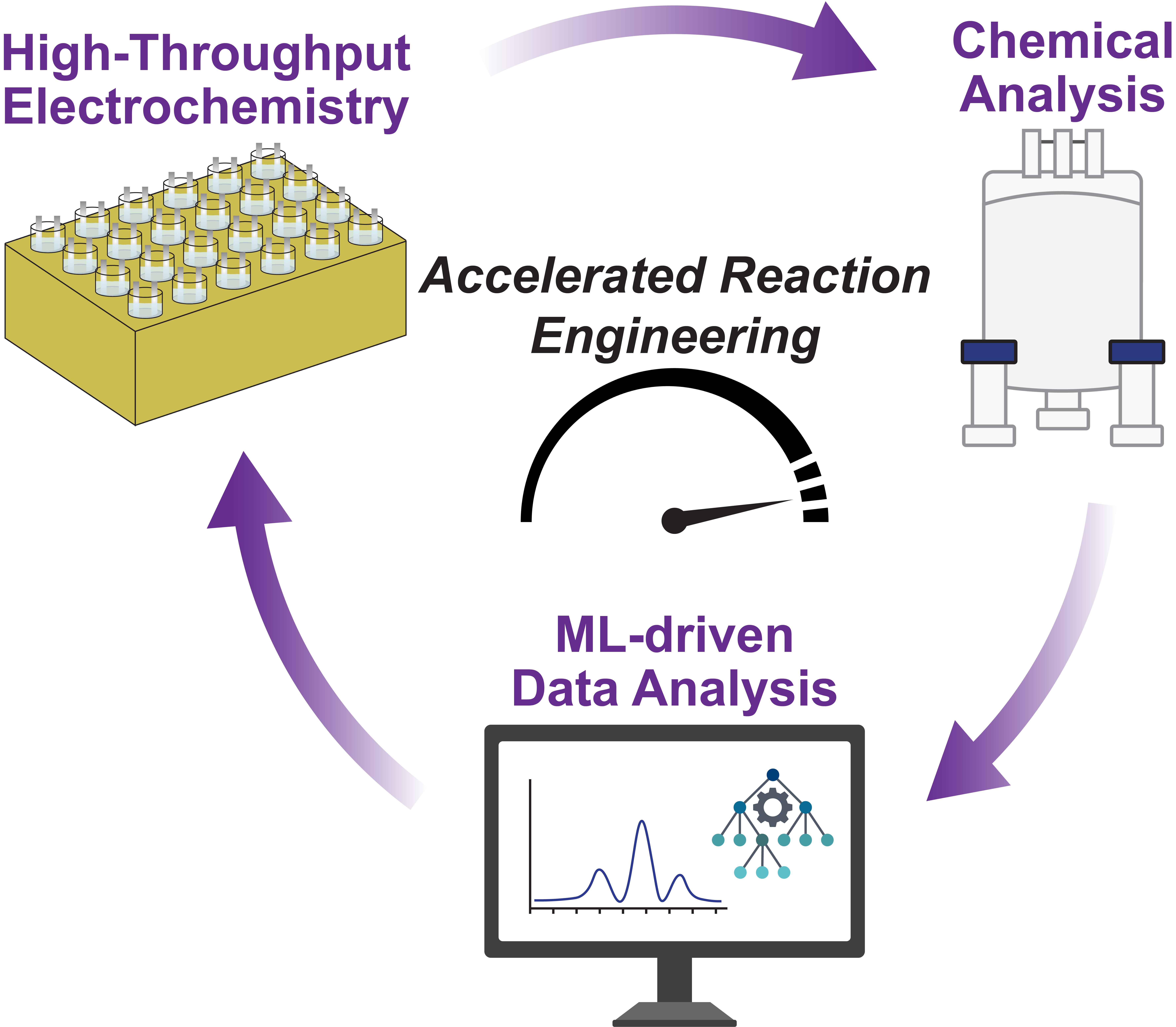
- While high-throughput electrochemical screening methods dramatically accelerate experimental workflows, chemical analysis of the resulting complex mixtures emerged as a critical bottleneck in the research process. Traditional analytical techniques struggle to match the rapid data generation of high-throughput screening, creating a fundamental disconnect between data acquisition and data interpretation speeds. The challenges in analyzing complex mixtures, particularly using nuclear magnetic resonance (NMR) spectroscopy, is that spectra interpretation requires significant manual intervention due to multiple overlapping peaks and shifts in peak positions between samples caused by differences in pH, ionic strength, or other intermolecular interactions.5,6 For high-throughput experimentation to be truly effective, it must be paired with equally capable high-throughput analysis methods to ensure that the rapid generation of reactions translates to useful data for decision-making. To address this analytical bottleneck, we developed computational approaches for analyzing complex NMR spectra from electrochemical experiments. Classical integration methods proved inadequate for quantifying convoluted peaks in our complex mixtures, requiring more sophisticated analytical techniques. We implemented neural networks for quantification of up to five different molecules with overlapping peaks, complemented by Support Vector Machines (SVMs) for classification of molecules in complex mixtures. These machine learning models typically require extensive training datasets for optimal performance, which would be prohibitively expensive and time-consuming to generate experimentally. Instead, we created synthetic training data by computationally combining experimental spectra of isolated molecules, generating hundreds of thousands of training examples in silico. This approach enabled accurate quantification of concentrations in complex organic mixtures while only requiring a small number of experimental samples for validation, seamlessly integrating with our high-throughput screening workflow.
This integrated approach combining high-throughput experimentation with machine learning-enhanced analysis, establishes an accelerated research cycle where data generation and interpretation operate at comparable speeds of 100’s experiments per day. The experimental generation of complex parameter relationships feeds into rapid analytical systems, producing insights that guide subsequent experimental design. This system reduces the time from hypothesis to discovery, enabling efficient exploration of previously inaccessible regions of electrochemical parameter space and establishing a generalizable framework for accelerating discovery in complex chemical systems.
1. Rein, J., Lin, S., Kalyani, D. & Lehnherr, D. in The Power of High-Throughput Experimentation: General Topics and Enabling Technologies for Synthesis and Catalysis (Volume 1) 167-187 (ACS Publications, 2022).
2. Wills, A. G. et al. High-Throughput Electrochemistry: State of the Art, Challenges, and Perspective. Organic Process Research & Development 25, 2587-2600, doi:10.1021/acs.oprd.1c00167 (2021).
3. Mathison, R. et al. Accelerated analysis of the electrochemical production route for biomass-derived adiponitrile. Chem Catalysis 4, doi:10.1016/j.checat.2024.100998 (2024).
4. Rein, J. et al. Unlocking the Potential of High-Throughput Experimentation for Electrochemistry with a Standardized Microscale Reactor. ACS Cent Sci 7, 1347-1355, doi:10.1021/acscentsci.1c00328 (2021).
5. Hao, J. et al. Bayesian deconvolution and quantification of metabolites in complex 1D NMR spectra using BATMAN. Nat Protoc 9, 1416-1427, doi:10.1038/nprot.2014.090 (2014).
6. Schmid, N. et al. Deconvolution of 1D NMR spectra: A deep learning-based approach. J Magn Reson 347, 107357, doi:10.1016/j.jmr.2022.107357 (2023).