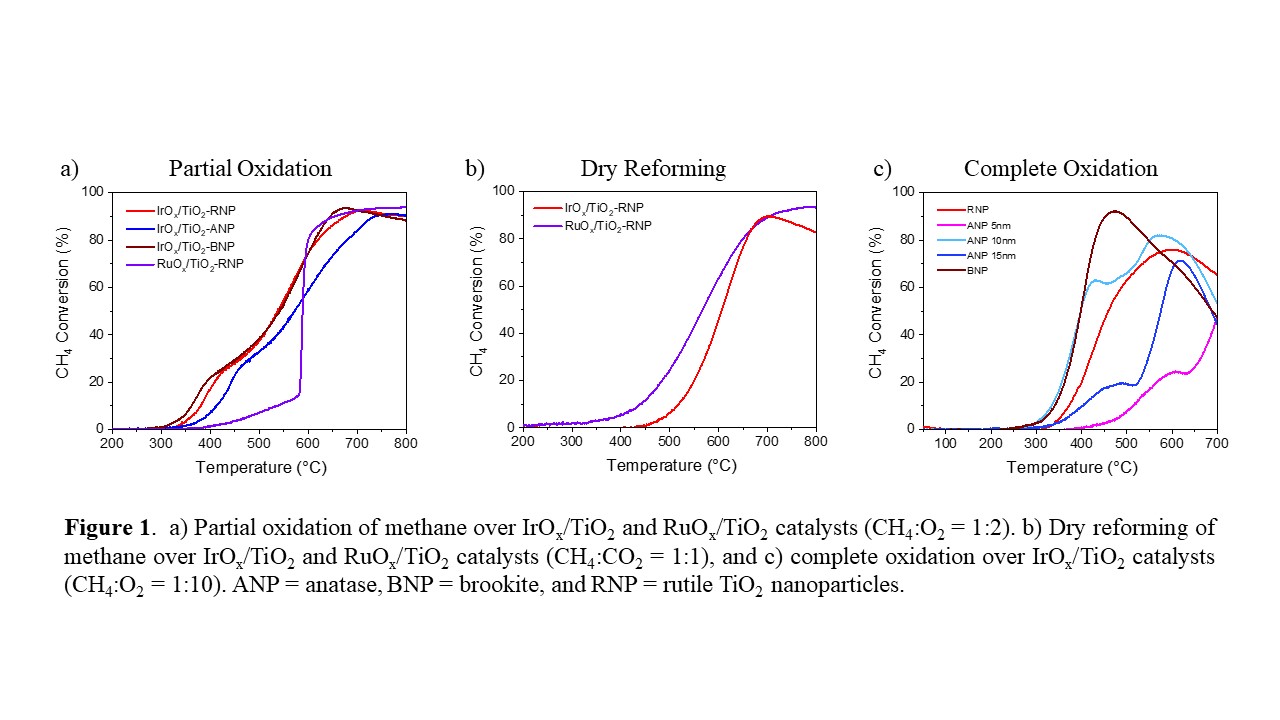
Selective oxidation of methane to higher value chemicals is a desired albeit challenging pathway to utilizing natural gas, as, in the presence of oxygen, avoiding overoxidation to the most thermodynamically stable products, i.e. carbon dioxide and water, is difficult at best. Rutile iridium dioxide with (110) surface facets is particularly promising due to its potential for activating methane below room temperature. However, the presence of gas phase oxygen tends to block active sites, requiring higher temperatures for catalytic turnover and making it more difficult to avoid overoxidation. Our group has evaluated the effects of titania structure (anatase, brookite and rutile) on the complete and partial oxidation as well as dry reforming of methane over titania-supported pure and mixed iridium-ruthenium oxides to gain insight into methane activation and reaction over these catalysts. Low loadings of active metals were utilized (0.5% by weight) to maximize metal-support interactions and to limit the cost of expensive metals. Titania-supported ruthenium dioxide catalysts have a distinctly different behavior in these reactions compared with iridium dioxide catalysts on the same support. Under partial oxidation conditions, the IrO
x/TiO
2 catalyst is more active at lower temperatures than the RuO
2/TiO
2 catalyst (Figure 1a), while under dry reforming conditions, the RuO
2/TiO
2 is slightly more active than IrO
x/TiO
2 (Figure 1b). Furthermore, the titania structure does not significantly influence the catalytic activity over IrO
x/TiO
2 catalysts under partial oxidation conditions (Figure 1a), i.e., under oxygen-limited methane oxidation. In contrast, the activity in the complete oxidation of methane (excess oxygen) over IrO
x/TiO
2 catalyst depends not only on the titania crystal structure (anatase, brookite and rutile), but also the titania particle size (Figure 1c). These results indicate a complex influence of titania support structure on the catalytic properties, but also reveal a potential for tuning the methane activation and reaction over IrO
x-RuO
x/TiO
2 catalysts.