2024 AIChE Annual Meeting
(573c) Sustainable Resources for the Synthesis of Aromatic Feedstock
Authors
Today’s chemical industry is based mostly on commodity chemicals that are produced on a large scale. They make up the raw materials that are used to manufacture many of the industrial products such as plastics, electronics, fertilizers and more. Aromatic compounds, such as benzene, toluene and xylene (BTX) make up a significant portion of the commodity chemicals. In 2022 the production of benzene amounted to roughly 60 million metric tons worldwide with projections showing further increase in production capacities.[1] The application sectors of the BTX fraction are multifaceted. While benzene is typically used in gasoline blending to improve knocking characteristics, it also serves as the chemical building block for many other chemical compounds such as ethylbenzene or aniline. Another important field stems from the oxidation of p-xylene to produce terephthalic acid, an important monomer for the production of various polymers, such as polyethylene terephthalate (PET). Currently BTX compounds are almost exclusively produced from fossil resources. Roughly 70% of the total world supply of BTX stems from reformed naphtha. The remainder originates from cracked gasoline byproduct from ethylene plants and coal liquids that are produced in coke ovens.[2] With respect to the transition of the chemical industry towards more sustainable production processes and away from the use of fossil resources, it can be expected that the aforementioned raw material streams for the production of many industrial products will decrease in availability.
Thus, a review of the open literature was conducted to identify possible renewable resources and thermochemical conversion processes to obtain aromatic feedstock. Furthermore, means of increasing the aromatic content of respective material streams were investigated. Other concepts with the goal to transform renewable resources that are known to literature, such as Bio refineries or hydrothermal conversion processes and more were not considered, as aromatic compounds typically only make up small fractions of respective product streams.
Results
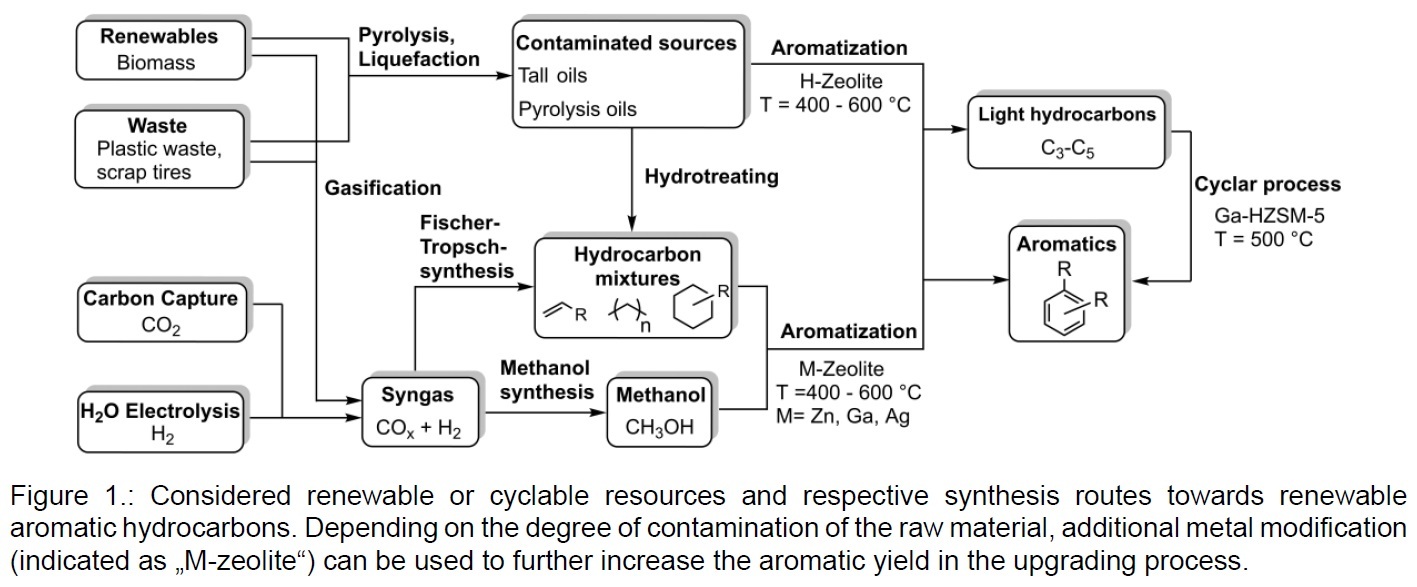
Figure 1 shows possible resource streams and respective upgrading processes to obtain aromatic feedstock that were considered. Renewable biomass is mainly comprised of wood, fats and oils. In terms of quantity the most relevant chemical compounds in this category are Cellulose, Lignin and other polysaccharides as they make up the main constituents of wood. In comparison fatty acids have limited availability and typically production pathways of industrial products that are structurally related have already been established. Furthermore, the competition with biofuels and food production makes the use of oils and fats to produce aromatics increasingly unattractive. In contrast, the challenge with the utilization of the constituents of wood lies in the extraction of pure chemical compounds from respective resources due to chemical linkage and oxygen content present in lignocellulose. Similarly wastes such as plastics or scrap tires require pretreatment processes to break chemical bonds and generate material streams that can be utilized.
Pyrolysis and Gasification processes are actively being investigated to transform renewable biomass and wastes into liquid oils and syngas respectively. In both cases subsequent possibilities for upgrading are greatly dependent on the quality of the obtained oils and gas mixtures. Sulfur-, nitrogen- and oxygen compounds can negatively impact performance and stability of heterogeneous processes that employ catalysts to facilitate for example methanol synthesis or aromatization reactions. Thus, prior to upgrading of resource streams costly purification is often required and further research in this area is required to find suitable methods to decrease the content of impurities in pyrolysis oils as well as gasification product mixtures.
Alternatively, capturing carbon dioxide from the atmosphere can present a pathway that is not reliant on purification processes. Using clean hydrogen, that originated for example from water electrolysis, methanol can be produced, which can act as a platform chemical to produce aromatic compounds. However, currently methanol obtained in this way is more expensive than the conventional fossil resource-based production pathways and further research is required to lower the costs of renewable methanol.
Depending on the degree of impurity atoms in the form of nitrogen, oxygen, sulfur and others, present for example in pyrolysis oils, different routes for aromatization are considered. Commonly used catalysts for the upgrading of hydrocarbon mixtures as well as methanol are based on zeolite materials. Here, the MFI-type zeolite ZSM-5 is the most prevalent used support- as well as active-material. Generally the proton form of the zeolite HZSM-5 is actively being investigated in upgrading processes like pyrolysis due to its desulfurization and deoxygenation properties to obtain higher quality oils. Other applications of ZSM-5 include bifunctional catalysts combining acidic and metal species. Additional doping with metal atoms such as zinc, gallium or silver increase the selectivity towards aromatic hydrocarbons in the product mixture of upgrading processes. However, the use of an active metal species introduces the vulnerability towards impurities like sulfur and nitrogen containing compounds. Current topics of interest in the research field are the underlying mechanisms of aromatization reactions as well as limited catalyst stability and respective mechanisms of deactivation.
[1] Statista Search Department, “Market volume of benzene worldwide from 2015 to 2022, with a forecast for 2023 to 2030”, can be found under https://www.statista.com/statistics/1245172/benzene-market-volume-world…, 2023.
[2] R. A. Meyers, Handbook of Petroleum Refining Processes, McGraw-Hill Education, New York, N.Y., 2016.