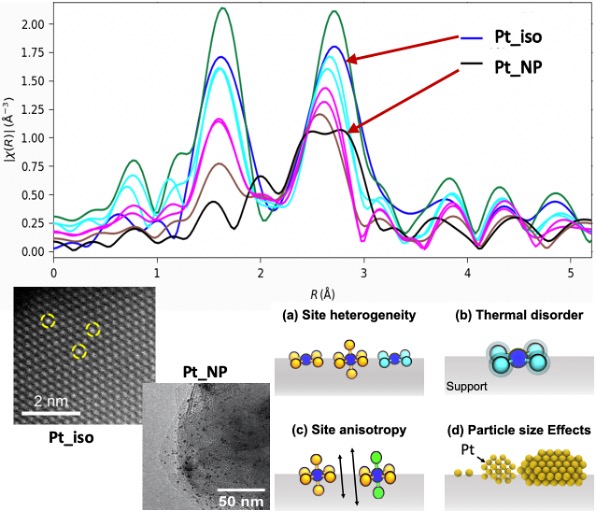
Simulations are often employed to elucidate atomistic phenomena that are experimentally inaccessible. Recently, we demonstrated one such approach, where a database of structures (obtained from density functional theory (DFT)) is utilized to identify the catalytic site that is most consistent with spectroscopy (e.g., XAS (x-ray absorption spectroscopy) and FTIR (Fourier transform infrared spectroscopy)) and microscopy data.
1 This approach, denoted as
QuantEXAFS, is especially powerful for relatively well-defined materials like atomically dispersed catalysts.
Expanding on the capabilities of QuantEXAFS we have developed a workflow that enables the quantification of site heterogeneities in catalytic systems. We call this method multi-site (MS)-QuantEXAFS, which is a python based automated workflow that uses DFT structures and experimental EXAFS data to quantify the site heterogeneities. Methods like MS-QuantEXAFS are extremely useful in catalyst design and synthesis as the concept falls at the junction of experimental and computational catalysis. Through this talk we aim to share the insights on the capabilities of MS-QuantEXAFS for atomically dispersed Pt/MgO. Additionally, we will discuss the methods that were employed in benchmarking the workflow and the applicability of this workflow to other atomically dispersed catalytic systems such as Pd/MgO used for ethylene hydrogenation.
To benchmark the MS-QuantEXAFS code, known fractions of physically mixed samples were studied using X-ray absorption spectroscopy (XAS) at SSRL under cryogenic conditions to minimize thermal attenuations. MS-QuantEXAFS workflow was utilized to calculate the fraction of contributions from the density functional theory (DFT) models for fitting the EXAFS spectra of the physically mixed samples. Overall, MS-QuantEXAFS serves as a combined experimental and computational methods to quantify sites in atomically dispersed catalysts, and we posit that this will lead to a better understanding of targeted site-controlled synthesis, activity, and stability.
Reference:
- Chen & Rana et al., J. Am. Chem. Soc. 2021, 143 (48), 20144–20156.