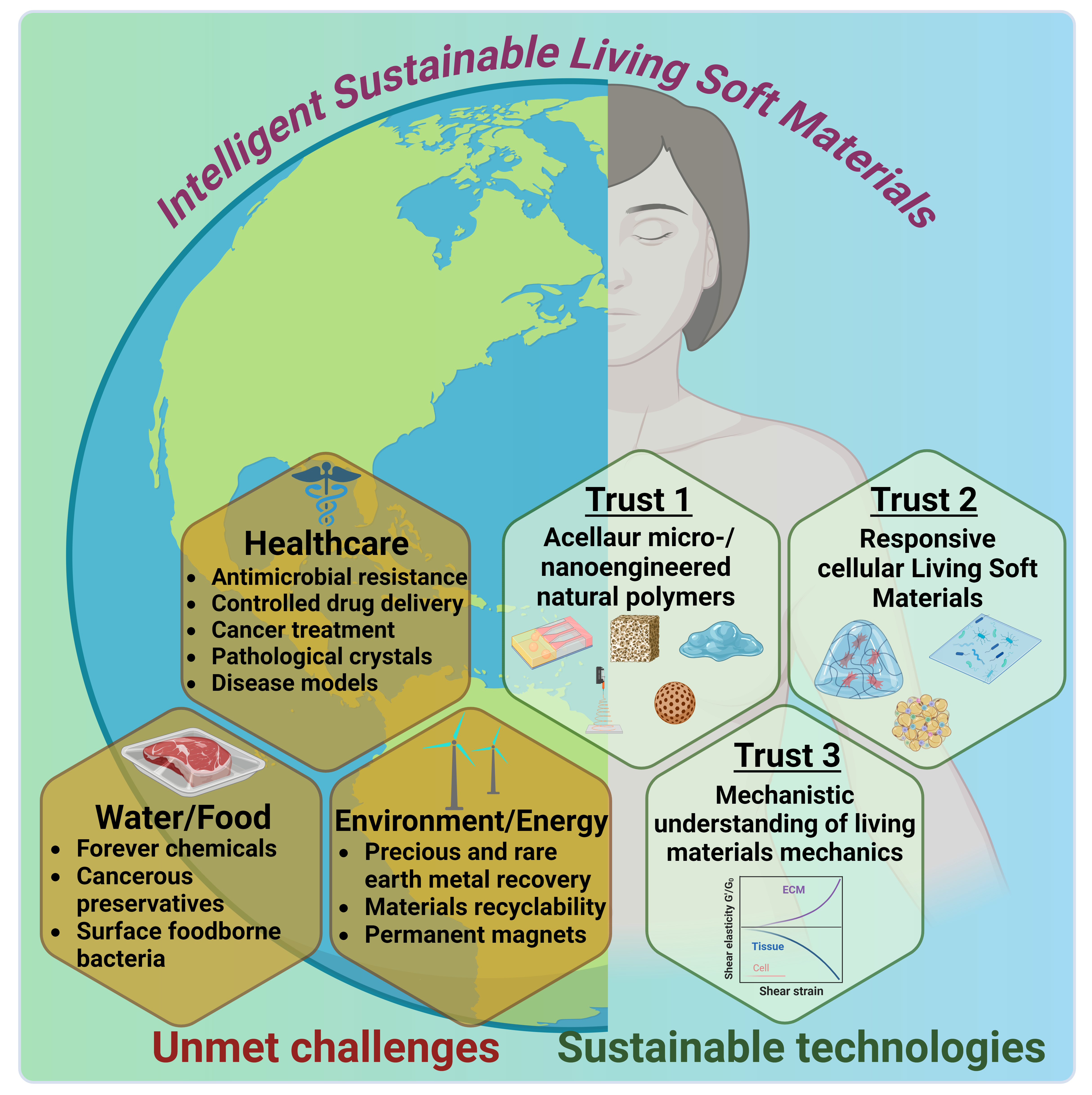
An important pillar of United Nations’ sustainable development goals (SDGs) is the creation of intelligent multifunctional materials derived from renewable resources for real-life applications. Developing innovative nanotechnologies using natural materials and green chemistry may bring us closer to this objective. Within this approach, living soft materials, which encompass cellular and/or acellular components, play a pivotal role. I am highly passionate about launching an interdisciplinary and translational research program aimed at developing living soft materials for a wide range of applications in advanced healthcare areas such as antibiotic resistance, tissue engineering, disease models, pathological crystallization and cancer treatments, as well as in environmental remediations, metal recovery, material surface coating, and smart packaging films. These emerging living materials, whether incorporating cell compartments (cellular) or not (acellular), will mimic the characteristics of biological systems, including self-healing, self-sustainability, self-replication, self-regulation, and environmental/mechanical responsiveness.
Research Interests
My diverse research pursuits primarily involve micro/nanoengineering of natural and semi-natural materials via green chemistry approaches to develop intelligent, sustainable acellular and cellular living soft materials, characterized by tailored structure-property relationships. I am particularly enthusiastic about the interdisciplinary synergy achieved by transforming biopolymers (i.e., polysaccharides and proteins), with or without living compartments (i.e., mammalian cells, bacteria, fungi, and yeast), into living platforms that better serve humans. My research interests are structured into three trusts:
Trust 1: Micro-/Nanoengineered Natural Polymers via Green Chemistry
Inspired by living materials, design, fabrication, and characterization of nature-based acellular platforms (i.e., conventional/Pickering emulsions, bulk/granular hydrogels, films, emul/aero/cryogels, and microparticles) via sonication, electrospinning, microfluidics, and 3D printing techniques
Trust 2: Cell-laden Responsive Living Soft Materials
Design and engineer living soft materials, also known as biohybrid materials, via incorporating beneficial bacteria and/or mammalian cells into non-living sustainable platforms to address persistence challenges in healthcare and environment
Trust 3: Mechanistic Understanding of Living Materials Mechanics
Explore the underlying mechanisms that enable materials to mimic the self-healing, strain-stiffening, adaptability, fatigue resistance, strength and toughness found in living organisms to advance the development of next-generation materials with responsiveness, enhanced durability, and sustainability across
Teaching Interests
My background in “Chemical Engineering” and “Chemistry”, along with my graduate research in micro-/nanoengineering, chemical functionalization, and characterization of bio-/biobased materials and developing living soft material platforms, makes me confident in teaching a wide range of courses at both undergraduate and graduate levels in the areas of Biopolymer Chemistry, Engineered Living Materials, and Bio-Soft Matter Chemistry and Engineering. These courses include, but are not limited to, Analytical Chemistry, Biochemistry, Colloid Chemistry, Mechanics of Composite Materials, Physical Chemistry of Polymers, and Introduction to Polymer Engineering.
I also would like to design and teach an interdisciplinary course titled Sustainable and Living Soft Matter Engineering.This course will cover the principles and practices of green chemistry, living soft matter engineering, and sustainable composites, providing a comprehensive understanding of the design, development, and application of advanced, eco-friendly materials. I aim to provide students with a comprehensive understanding of both the fundamental and advanced soft matter concepts in the chemical engineering field with respect to the latest research and technological advancements. My goal is to prepare students to become innovative and responsible scientists and engineers who can contribute to sustainable, green solutions in healthcare and environmental applications.