Breadcrumb
- Home
- Publications
- Proceedings
- 2024 AIChE Annual Meeting
- Process Development Division
- Process Intensification - Novel Reactors and Process Integration
- (491a) Nanofluid-Induced Droplet Pinch-Off during Liquid-Liquid Flow in Mesoscale

The advent of miniaturized devices has revolutionized process intensification. These devices are designed to maximize surface area, ensuring efficient mass transfer, effective mixing, minimized waste generation, and easy scalability. Miniaturization for process intensification is applicable to exothermic liquid-liquid reactions, fast or instantaneous reactions, etc. Accordingly, several studies are reported for biphasic liquid flow in reduced dimensions. However, the majority of the studies [1] are reported in microchannels. Biphasic flow in mesoscale has not received much attention where mesoscale is quantified [2] as 0.57 < Co < 4.46 (Co, confinement number= 1/D√σi/gΔρ, and Δρ, D, σi and g are difference in liquid densities, conduit diameter, interfacial tension and gravitational acceleration respectively). Further, previous researchers have shown that reduced dimensions offer a controlled environment for continuous production of droplets in flow system. Droplet formation in a controlled and reproducible manner is relevant for material science applications, e.g., in pharmaceutical, fine chemicals and food industries. Most of these applications require uniform droplet size for consistent and predictable results. Monodispersed droplets are also essential to improve productivity and product quality. Till date, the past studies have reported formation of micro droplets in microchannels. In industrial applications, achieving uniform droplet sizes at higher throughput remains a challenge. Furthermore, elongated droplets (length ≥ twice the conduit diameter) are desirable for enhancing the rate of transport processes due to increased interfacial area and internal convection.
With these considerations, the present study proposes a unique technique to produce elongated monodispersed droplets at higher throughput during biphasic liquid flow in the mesoscale. The technique uses an aqueous nanofluid (NF) to pinch-off droplets of the immiscible organic liquid during biphasic liquid flow in a 2 mm diameter glass conduit. The droplets are produced without contaminating the organic phase.
The nanofluid (NF) comprises of Al2O3 nanoparticles (20-50nm), sodium dodecyl sulfate (surfactant), and de-ionized water. Two nanofluids NF-1 and NF-2 are prepared with 0.01 vol% and 0.02 vol% Al2O3 respectively. The surfactant proportion is same (0.4 wt.%) in the two cases. The NF (carrier phase) is introduced with toluene, colored red with iodine (dispersed phase) in a 2mm diameter, 1m long transparent vertical tube by programmable dual syringe pumps. The flow rates of the two fluids are varied from 1 ml/min to 80 ml/min. Initially, the flow rate of the carrier phase is kept constant at 1ml/min and the flow of the dispersed phase is gradually increased from 1 to 80ml/min. The process is then repeated at higher flow rates of the carrier phase. The visualization studies are performed by a high-speed camera (Nikon Micro LC 320S) at the entry to understand the underlying mechanisms of droplet pinch-off and at 40 cm from the entry, where the flow is fully developed. Additional experiments are performed with water-toluene (W-T) and surfactant-toluene (S-T) to understand the influence of surfactant and nanoparticles on the flow distribution.
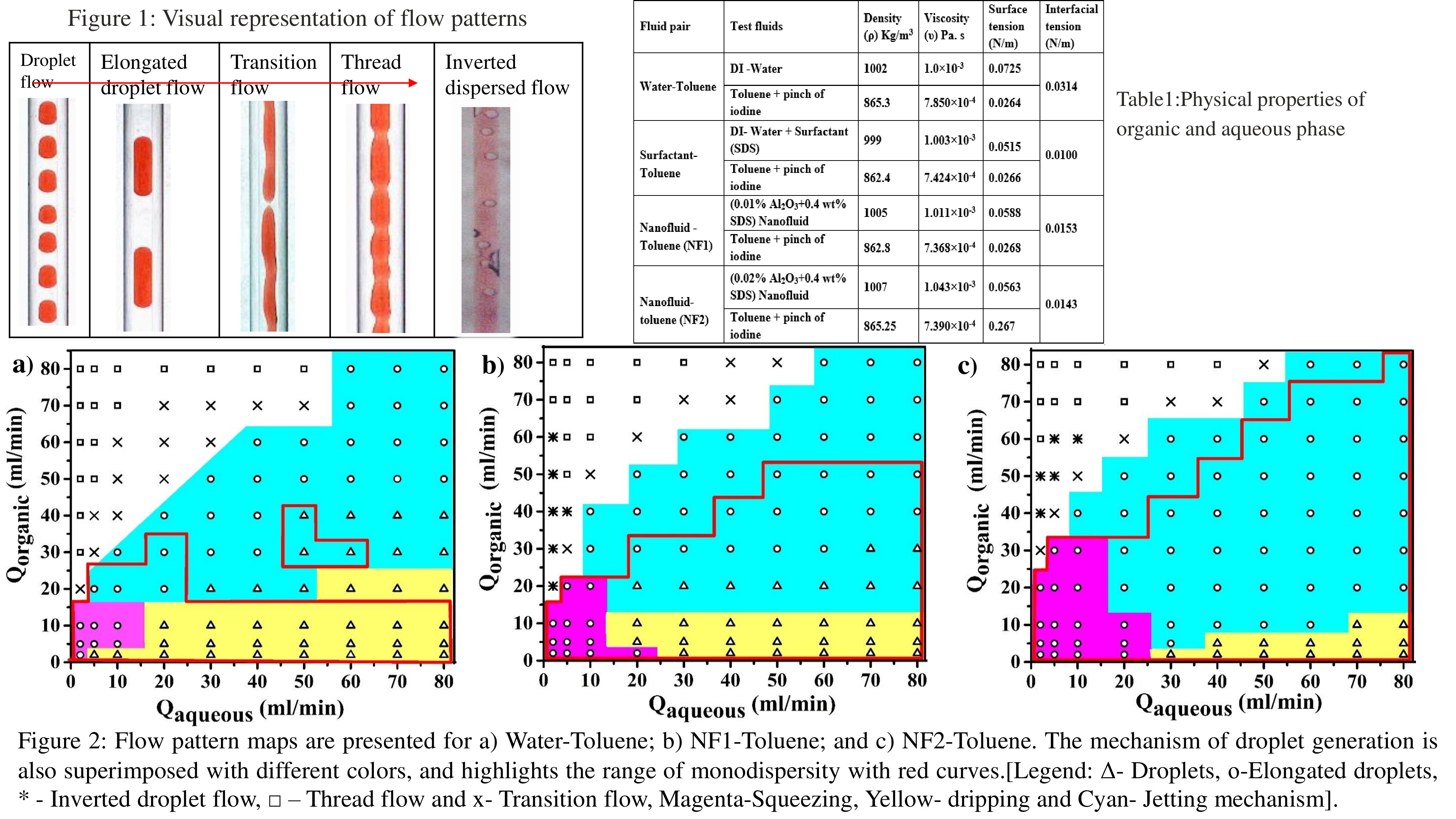
The flow patterns observed are droplet, inverted droplet, elongated droplet, thread, and transition between thread and elongated droplet flow (Figure 1). During droplet flow, the organic phase is dispersed in the carrier phase, while the reverse occurs during inverted droplet flow. Elongated droplets are characterised by Ld ≥ 2(conduit diameter), where the average droplet length is estimated from 50 droplets under the same flow conditions. Our observations at the entry section further reveal that the droplets are generated by squeezing, dripping, and jetting mechanisms. Squeezing occurs at low phase flow rates while dripping occurs at high aqueous and low organic flow rates. The most predominant mechanism is jetting. It occurs at high phase flow rates.
The range of existence of the different flow patterns is presented as flow pattern maps in Figure 2 for a) water(W)-toluene(T), b) NF1-T and c) NF2-T. Droplet, elongated droplet, inverted droplet, thread flow and transition are represented by Δ, ο, *, □ and x respectively. The mechanism of droplet generation is also superimposed in the figures and denoted by magenta (squeezing), yellow (dripping) and cyan (jetting). Additionally, the range of monodispersity is displayed by a red curve in all the figures. The experiments reveal -
In order to investigate the effect of aqueous and organic phase properties on flow distribution, we have measured density, viscosity and surface tension of the test fluids and the interfacial tension of the different fluid pairs (W-T, S-T, NF1-T and NF2-T). Table 1 indicates that NFs have practically the same density and viscosity as water. Therefore, changes in flow morphology can be associated with change of interfacial tension. Introducing nanoparticles to the surfactant solution reduces interfacial tension to some extent, but not below that of surfactant solution. Additionally, interfacial tension of NF decreases with increase in nanoparticle concentration at a constant proportion of surfactant. This suggests that the observed flow phenomena cannot be solely explained by changes in interfacial tension. Previous studies [5] have reported that nanoparticles and surfactants form a complex structure (NPS), which settles at the interface. We show this to be responsible for the production of monodispersed elongated droplets over a wide range of flow conditions in the present study.
The study offers valuable insights into the influence of nanoparticles on the flow distribution in biphasic liquid flow at the mesoscale. The salient conclusions are
5. References