Breadcrumb
- Home
- Publications
- Proceedings
- 2024 AIChE Annual Meeting
- Engineering Sciences and Fundamentals
- Particulate and Multiphase Flows: Emulsions, Bubbles, Droplets
- (400f) Towards 'factory in a Box' for Tailored Emulsions

In recent years, there is an increasing interest in using hydrodynamic cavitation devices for generating emulsions [2, 4]. Recently Thaker and Ranade [5] and Upadhyay et al. [6] have reported effective use of vortex-based hydrodynamic cavitation devices for producing oil in water emulsions up to 60% oil volume fraction. Such compact devices offer an excellent potential for applications towards on-demand manufacturing of customised emulsions. In this work, we present a critical review of performance and characteristics of oil in water emulsions using vortex-based cavitation devices with an objective of developing a ‘factory in a box’ platform for truly distributed manufacturing of emulsions. The focus is on clearly defining desired attributes needed for ‘factory in a box’ platform and providing critical evaluation in terms of:
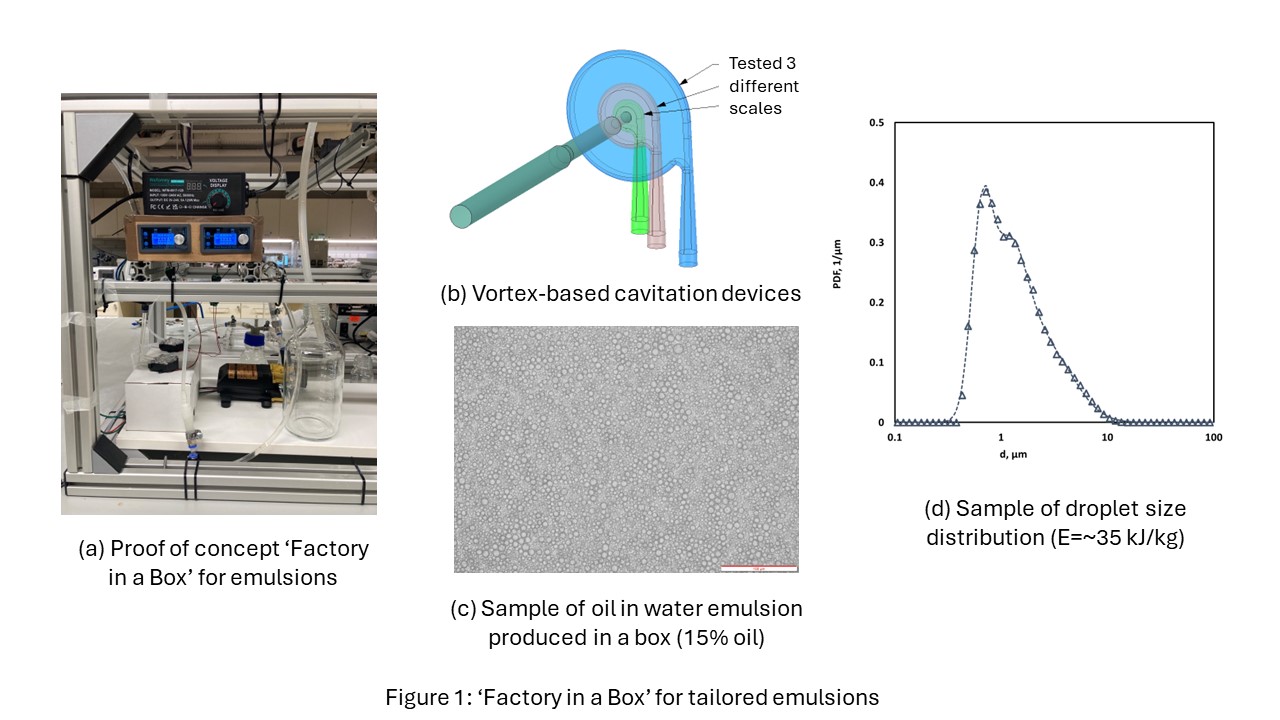
Based on this work, a proof of concept of ‘factory in a box’ producing emulsions is established (see Figure 1a) for producing emulsions at ~100 ml/min capacity. Vortex-based hydrodynamic cavitation devices at three different scales were used. Schematic of devices used in this work are shown in Figure 1b. The device dimensions are same as that disclosed by Ranade et al. [4]. The rape seed oil-in-water emulsions were produced. The continuous phase was water with 2 % (w/v) of TWEEN 20 (MP Biomedicals, LLC, France) surfactant. The quantity of surfactant was adequate to stabilise these emulsions up to 60% volume fraction of oil [6]. The cavitation device was operated with pressure drop of 200 kPa. A sample of emulsions produced in the factory in a box is shown in Figure 1c (as an image from microscope) and in Figure 1d (full DSD as measured by Malvern master sizer - 3000). An in-line turbidity sensor was used to characterise DSD. The performance of ‘factory in a box’ was evaluated for a range of oil volume fractions and flow rates of emulsions. The presented data will be useful for evaluating computational models of simulating droplet breakage in vortex-based cavitation devices. The devices used in this work show an excellent potential for applications towards on-demand manufacturing of customised emulsions. The presented results and critically analysis of emulsion producing devices will provide a sound basis for further work towards realising ‘Factory in a Box’ platforms for customised and personalised emulsions.
References: