Li Ping, East China University of Science and Technology
Natural gas (NG) is the cleanest fossil fuel, with low greenhouse gas (GHG) emission and fewer toxic pollutants on burning, playing a key role in the world’s low-carbon energy transition. Unconventional natural gas(UNG) is considered a future energy source that can replace NG. Biogas is a type of UNG, a mixture of CH4 (50-70%) and CO2 (30-50%). It is available from various types of organic feedstock, including agricultural crop residues, municipal solid waste, wastewater etc. Up to now, about 70% of biogas is utilized today for power generation and heat, 20% for cooking, and the other 10% is upgraded to biomethane (>92% CH4). Therefore, the separation of CO2 from biogas to upgrade CH4 not only helps to reduce GHG emissions, but also provides the economic benefits for fuel energy.
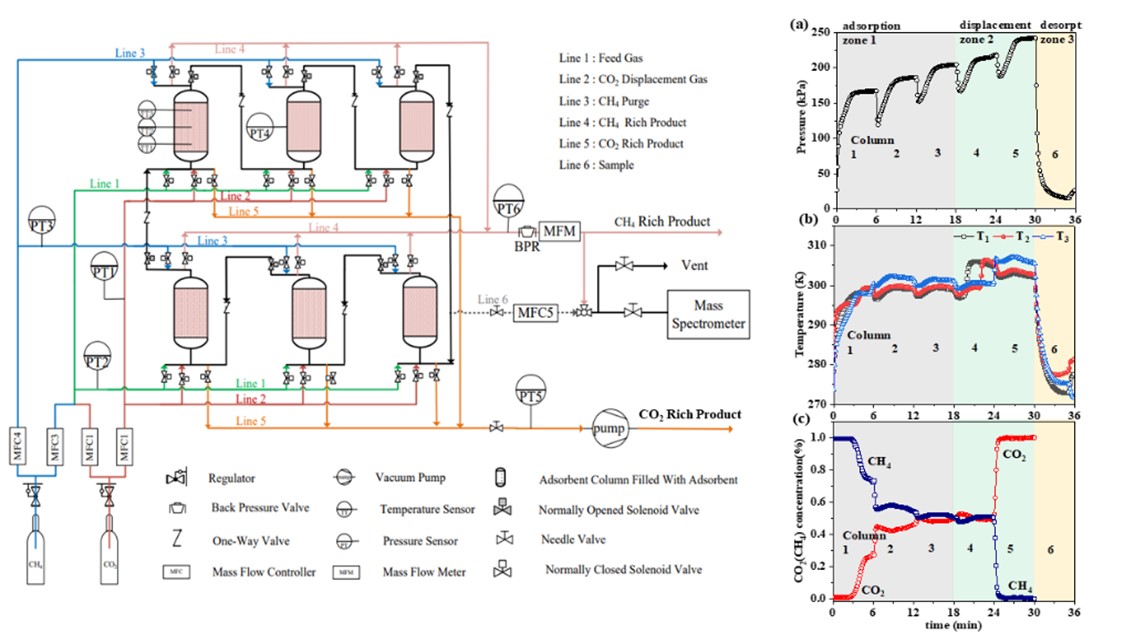
In this work, six ZSM-5 zeolites packed columns, three-zone pressure-swing simulated moving bed process (PG-SMB process) is developed to separate CH4/CO2 from biogas, where the packed ZSM-5 zeolites are the common microporous materials, with excellent specific surface area, specific pore structure, water resistance, no flammable. Experimental flowchart and typical results for CH4/CO2 separation by the PG-SMB process with six ZSM-5 zeolites columns are shown in Fig.1. The experimental results demonstrate that the six-column PG-SMB process filled with ZSM-5 zeolites can continuously obtain 95 % purity methane product gas from 30 %~60 % CH4 feed gas with CO2 impurity, and the methane recovery rate can reach more than 90 %. Therefore, the novel PG-SMB process can be used to separate CH4/CO2 from biogas to obtain a high purity methane product gas (95%) for direct integration into the natural gas pipeline network or for the preparation of liquefied natural gas (LNG).