2024 AIChE Annual Meeting
(276e) Award Submission: Designing a Magnetically Responsive Microbial Nanoculture System
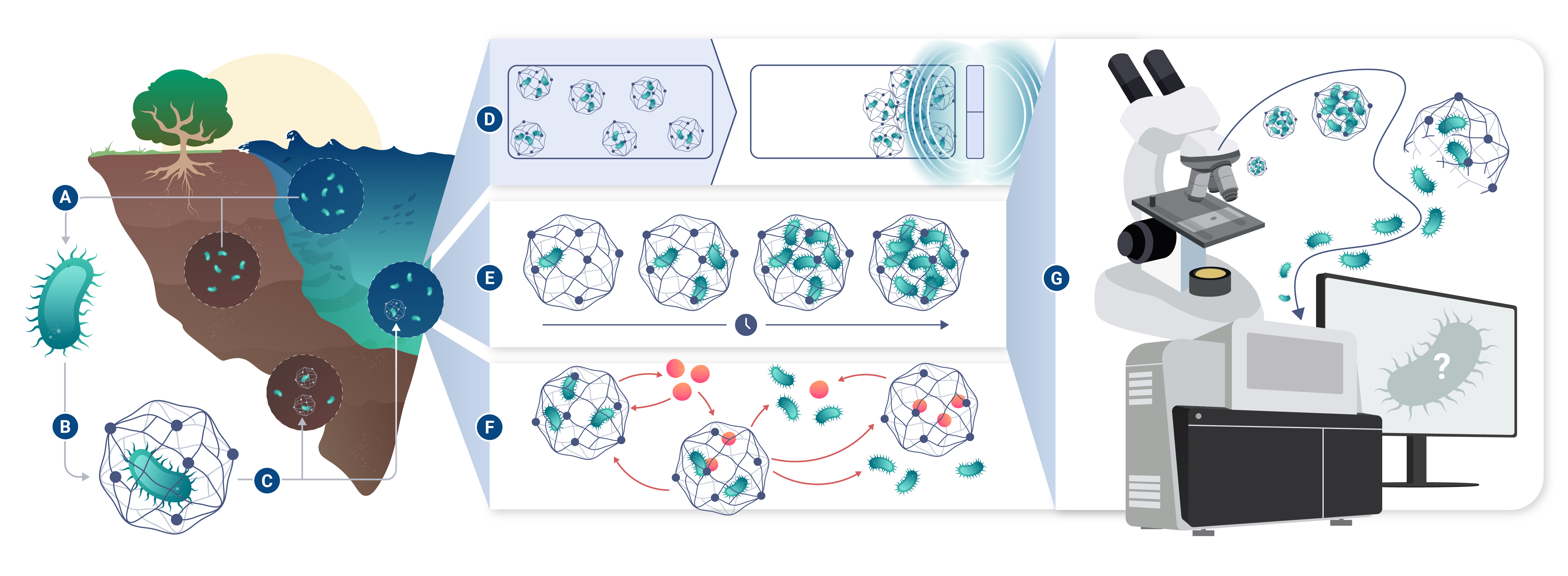
Background/Motivation: The study introduces magnetically functionalized nanocultures (MNCs) as a novel platform for the study of environmental microorganisms. The nanocultures are nanoliter-sized double emulsions, created using poly(dimethylsiloxane) (PDMS)-based membranes[1]. These nanocultures, equipped with semi-permeable membranes and magnetic nanoparticles (MNPs), aim to provide a solution to the long-standing challenge of cultivating and retrieving previously unculturable microbial species from environmental samples [2]. We hypothesize that the MNCs can be incubated in simulated natural environments, enabling the study of microbial growth dynamics, and the retrieval of MNCs after incubation without substrate confinement, preserving natural diffusion dynamics [3]. The study addresses the gap in our understanding of unculturable microorganisms, offering potential applications in drug discovery, high-throughput screening, and microbial ecology across various environmental conditions. Methods: Transmission and Scanning Electron Microscopy were performed to characterize the magnetic nanoparticles (MNPs) and generated nanocultures. Magnetic polymer membranes (MPMs) were characterized by measuring the water contact angles, mechanical testing, EDS point spectra, and elemental maps of the bulk MPMs. A vibrating sample magnetometer was employed to obtain the magnetic susceptibility of the functionalized polymers. Fluorescence intensity via confocal imaging was utilized to quantify bacterial growth in the NCs. Computational tools were used to obtain average size distributions of MNPs embedded within MPMs. Escherichia coli strains, including Enhanced Green/Red Fluorescent Protein-tagged variants, were encapsulated in MNCs and placed under silica beads to mimic soil-like conditions. The study demonstrates successful retrieval of MNCs using magnetic actuation without hindering microbial growth. Computational methods were employed to calculate the average velocity of the NCs. These novel nanocultures offer a means to study microbial growth under various environmental conditions while enabling retrieval for downstream omics studies. Results and Implications: Magnetic susceptibility as a function of field was measured by magnetometry and found to be 19 × 10-7, 12.6 × 10⁻⁷, and 12.0 × 10⁻⁷ emu/Oe for 10 nm, 20 nm, and 5 nm MNPs respectively. The average velocity of the MNCs under a magnetic field gradient of 1.48 T, was approximately 80 μm/s, 200 μm/s, and 130 μm/s for 5 nm, 10 nm, and 20 nm diameter MNPs, respectively. Simulations of magnetophoresis are in reasonable agreement with the main features of the experimental measurements. The study lays the foundation for further exploration of environmental microbiomes and the discovery of previously unknown microbial species and associated beneficial secondary metabolites. Future research questions include optimizing MNCs design for different environmental settings, investigating cross-kingdom species interactions within nanocultures, and expanding applications in drug discovery and therapeutic microbiology.
References:
[1] Usman, Huda et al. (2021) Design of a well-defined poly(dimethylsiloxane)-based microbial Nanoculture system. Materials Today Communications doi:10.1016/j.mtcomm.2021.102185.
[2] Manimaran, N.H.*, Usman, Huda* et al. (2020) Developing a functional poly(dimethylsiloxane)-based microbial Nanoculture system using dimethylallylamine, ACS Applied Materials and Interfaces, 12(45), pp. 50581–50591. doi:10.1021/acsami.0c11875.
[3] Usman. Huda et al (In Preparation), Designing Magnetically Responsive Nanoculture System.