2024 AIChE Annual Meeting
(188b) Development of Structurally Stable Mo-CHA Catalysts for Methane Dehydroaromatization with High Benzene Selectivity
Authors
Jaatani Abdi, Purdue University
Hien N. Pham, University of New Mexico
Abhaya Datye, University of New Mexico
Rajamani Gounder, Purdue University
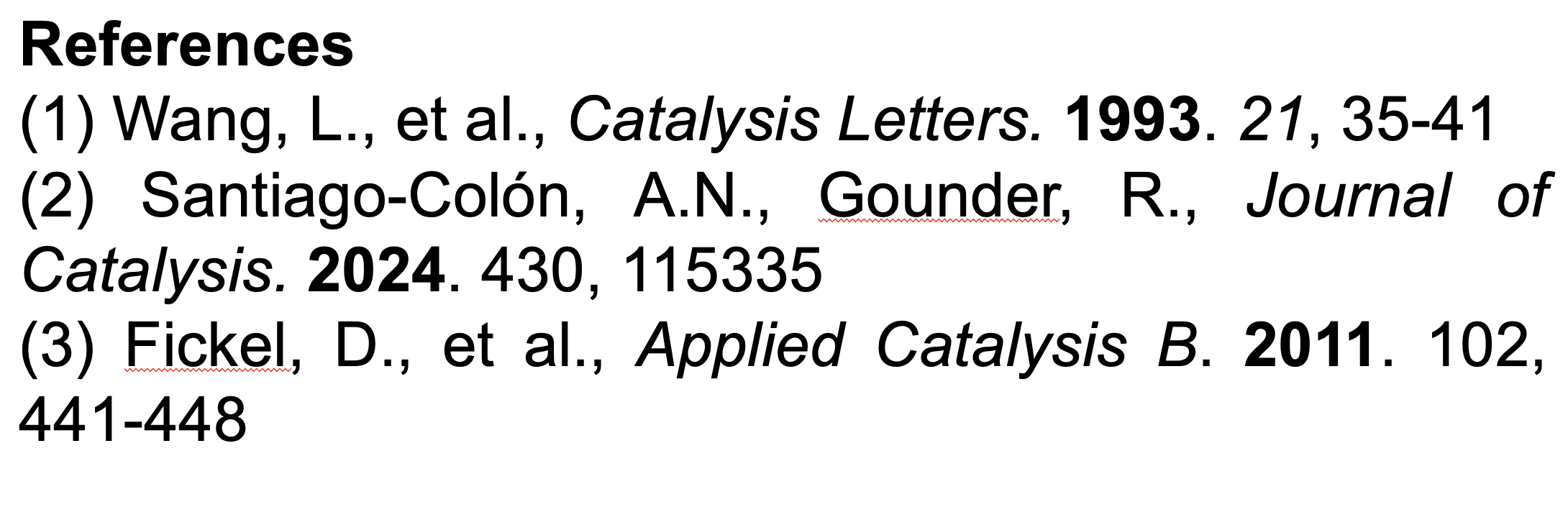
Molybdenum supported on MFI zeolites (Mo-MFI) facilitates Methane dehydroaromatization (DHA) with high aromatics selectivity (~80%) [1]. Carbonaceous deposits formed during reaction leads to rapid deactivation, which can be removed by O2 at relatively high-temperatures (>823 K). These regeneration protocols, however, result in decreases to methane DHA rates (per Mo) with each successive cycle because exposure of Mo-MFI to hydrothermal aging conditions leads to the loss of zeolitic H+ sites and thus the binding sites for ion-exchanged Mo species that are precursors to active Mo-carbides for methane DHA [2]. Here, we use chabazite (CHA) zeolites as the zeolite support due to its known structural resistance to hydrothermal aging conditions [3] and use H2 TPR, NH3 TPD, and HRTEM coupled with kinetic measurements to show that Mo-CHA catalysts remain structurally stable over several (>10) cycles of reaction-regeneration. CHA zeolites were also hydrothermally synthesized by adding organosilane surfactant to reduce crystallite sizes (<10-100 nm) to alleviate diffusion constraints for bulky aromatic products (>0.55 nm) imposed by smaller eight-membered ring (0.38 nm) windows. Catalysts were prepared by MoO3 deposition on CHA and MFI zeolites (Si/Al ~15), followed by oxidative treatments (823 K) to transform MoO3 into ion-exchanged Mo species. Initial forward DHA rates (950 K, 60 CH4 kPa) decrease systematically with increasing numbers of reaction-regeneration (20 O2 kPa) cycles for Mo-MFI. In contrast, rates remain constant for Mo-CHA and the fraction of ion-exchanged Mo species quantified by H2 TPR does not decrease upon regeneration. Furthermore, HRTEM imaging shows evidence for mesopore formation and Mo agglomeration in Mo-MFI catalysts after regeneration, while such structural changes are not observed in Mo-CHA. This work provides guidance for the design of Mo-zeolites with improved hydrothermal stability, which is a barrier to the development of a continuous reaction-regeneration process for commercially viable methane DHA strategies.