δ-Valerolactone (DVL) is a five-carbon cyclic ester that can be polymerized to yield biocompatible, chemically recyclable polyesters for use in medical implants and surgical instruments. While current market prices of petroleum-derived DVL are very high due to poor availability of C5 feedstock in petroleum, lignocellulosic biomass is rich in pentoses that can be catalytically upgraded to fine chemicals like furfural.
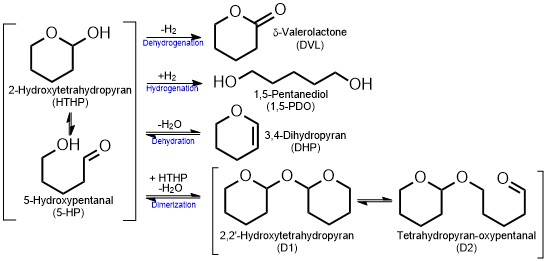
Herein, we demonstrate our patented route to DVL from dehydrogenation of furfural-derived 2-hydroxytetrahydropyran (HTHP) over Cu catalysts. However, HTHP is a cyclic hemiacetal that undergoes 3 other competing reactions during dehydrogenation to DVL, including: 1) Dehydration to 3,4-dihydropyran (DHP), 2) Dimerization to 2,2â-hydroxytetrahydropyran, and 3) Hydrogenation to 1,5-pentanediol (PDO) from H
2 generated
in situ (
Scheme 1). Since the thermochemistry of HTHP and its dimers is not available in existing databases, we have carried out DFT calculations at the level of theory: M06-2X/jun-cc-pVQZ//M06-2X/cc-pVTZ. DFT has shown that the ÎG
rxn of both DVL and DHP production decrease with increasing temperatures, with DVL being the most exergonic reaction at T>150°C and all other reactions being endergonic. Kinetic experiments carried out over Cu/SiO
2 catalysts show that the highest observed selectivity to DVL is 70% at 150°C. Products have been analyzed using temperature-variable NMR, GC, and HPLC, depending on the product phase. DVL production has an apparent activation energy of 10.3 kJ mol
-1 and is half-order with respect to HTHP partial pressure. We have also determined the reaction parameters of all competing reactions involved and developed a complex kinetic model for the system to optimize selectivity to DVL as a function of temperature, feed composition and HTHP conversion.