Oxidative dehydrogenation (ODH) of light alkanes is an exothermic, direct process to obtain light alkenes. ODH is a potential alternative for the conventional cracking-based processes, provided the product over-oxidation is addressed. The extent of over-oxidation can be reduced if CO
2 is used as a mild oxidant, though alkane conversion and product selectivity are still challenging. This combined experimental and theoretical work studies the CO
2-assisted ODH of light alkanes (C
2H
6 and C
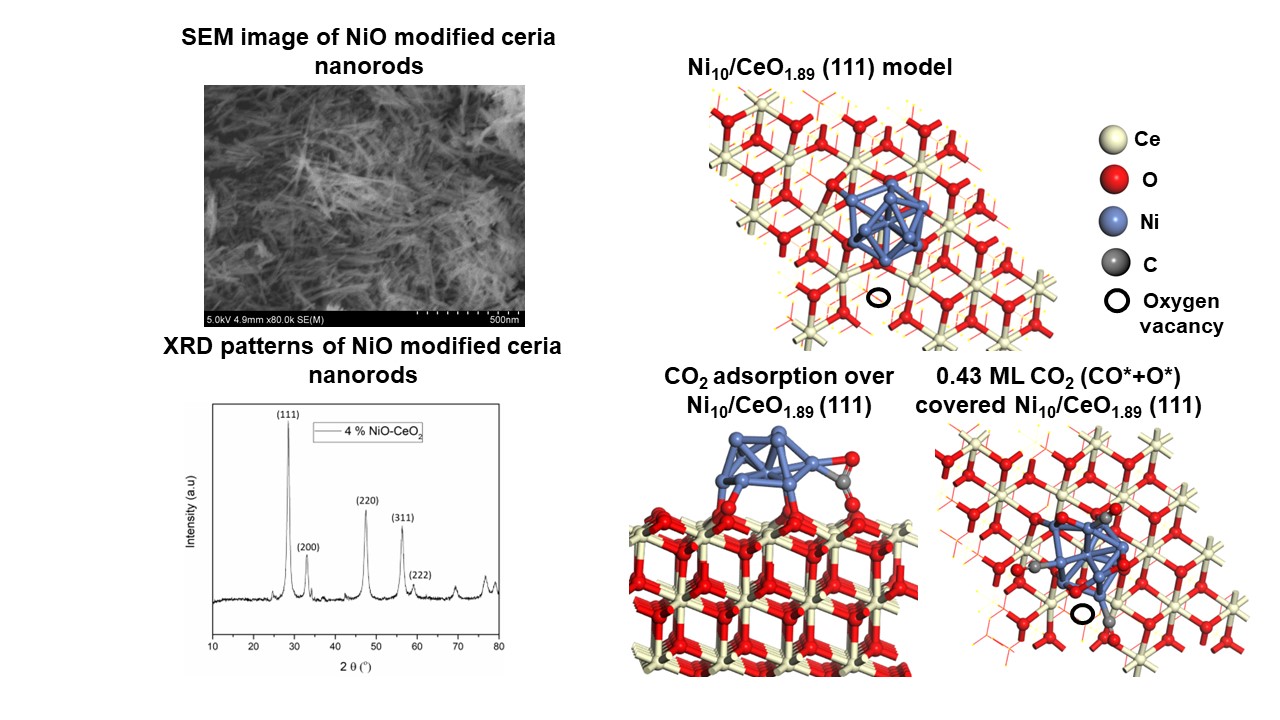
3H
8) over ceria and Ni modified ceria-based catalysts. The catalysts were synthesized using impregnation, hydrothermal and co-precipitation methods. The catalysts were characterized using X-Ray diffraction (XRD), scanning electron microscopy (SEM) and energy-dispersive X-ray spectroscopy (EDS) studies. These studies confirmed the formation of the crystallographic structure and morphology of the bare and modified catalyst, and the weight percent of Ni loaded. The electronic features will be studied using X-Ray photoelectron (XPS), Raman, and Fourier Transform Infrared (FTIR) spectroscopic analyses. Plane-wave-based periodic Density Functional Theory (DFT) calculations were carried out to study the CO
2-assisted alkane ODH over a representative ceria nanoparticle-supported Ni catalyst system (Ni
10/CeO
1.89 (111)). The oxygen vacancies present in the vicinity of the Ni-O-Ce interfacial sites of Ni
10/CeO
1.89 (111)
facilitate CO
2 adsorption (E
ads = -1.68 eV). CO
2 further gets activated over the Ni cluster and forms CO* and active O* species, of which the O* is one of the active species among the other active oxygens of the ceria surface that activates the C-H bond of alkane. DFT studies in conjugation with the
ab-initio thermodynamics calculations predicted a 0.43 monolayer (ML) coverage of dissociated CO
2 (CO*+O*) over Ni
10/CeO
1.89 (111) surface at typical propane ODH conditions (T = 773K and = 0.37 atm). Detailed propane ODH and representative overoxidation mechanistic studies are being done on this system. The developed mechanisms will further be validated using
in-situ DRIFTS analyses.