Methane (CH
4) emissions from natural gas-powered automobiles have become an immediate environmental concern. CH
4 has a â25-fold greater global warming potential than CO
2 and thus possesses a substantial environmental impact. Complete CH
4 oxidation can reduce emissions and Pd-based catalysts have a promising CH
4 oxidation activity [1]. Pd/zeolite catalysts with high Si/Al molar ratios are more hydrophobic, compared to lower Si/Al molar ratio zeolites, and have an improved CH
4 oxidation activity. Pd/SSZ-13 catalysts with low Si/Al molar ratios have shown a promising CH
4 oxidation activity, but Pd/SSZ-13 catalysts (Si/Al >100) are under investigated. Herein, 2 wt.% Pd/SSZ-13(156) was washcoated (1.1 g
washcoat/in
3) on cordierite minicores and its CH
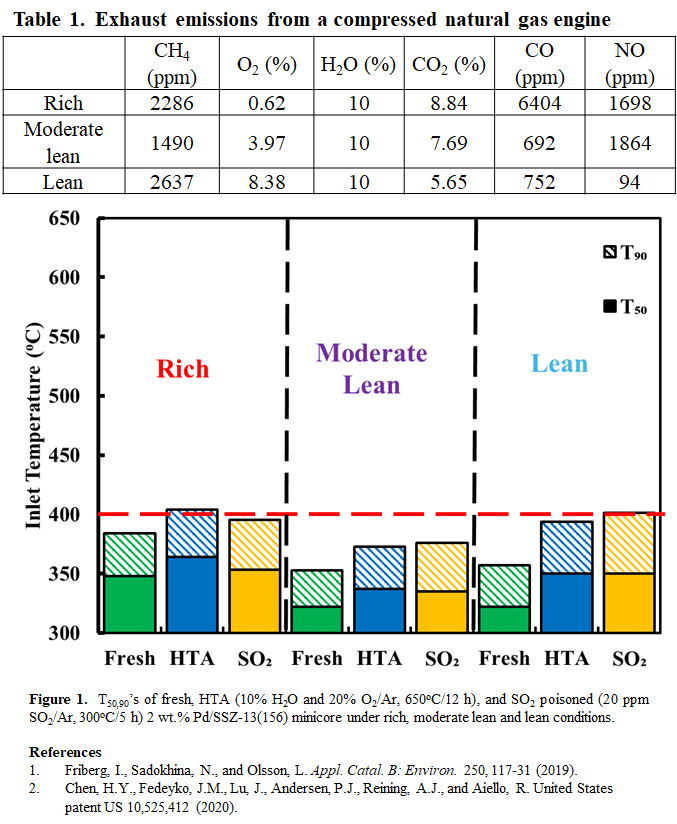
4 oxidation performance was evaluated under rich, moderate lean, and lean conditions under realistic conditions (Table 1). The Pd/SSZ-13(156) minicores were pretreated (20% O
2/Ar at 500
oC/20 min) and evaluated under rich, moderate lean, and lean conditions as single successive CH
4 oxidation cycles (200-650
oC (5
oC/min)). The results showed that the temperature that 90% CH
4 conversion was achieved was the lowest (353
oC) under moderate lean conditions compared to rich (384
oC) and lean (357
oC) conditions over Pd/SSZ-13(156) minicores (Fig. 1). The effect of hydrothermal aging (HTA) and SO
2 poisoning on the CH
4 oxidation performance of Pd/SSZ-13(156) minicores is reported here for the first-time with T
90's decreasing from lean (401
oC) to rich (396
oC) to moderate lean (376
oC). The majority of the deactivation was observed after HTA with a greater increase in the average T
90 of 26
oC compared to SO
2 poisoning (1
oC) over all conditions. The decrease in performance after HTA can be attributed to Pd sintering. Nevertheless, Pd/SSZ-13(156) exhibits excellent CH
4 oxidation performance with maximum T
90 observed under all studied conditions â¤401
oC after HTA and SO
2 poisoning, demonstrating hydrothermal stability and resistance to SO
2 poisoning for the abatement of CH
4.