2023 AIChE Annual Meeting
(655d) Aging Studies of Dual Functional Materials for Direct Air Capture with in Situ Methanation Under Simulated Ambient Conditions: Ru Thrifting for Cost Reduction
Authors
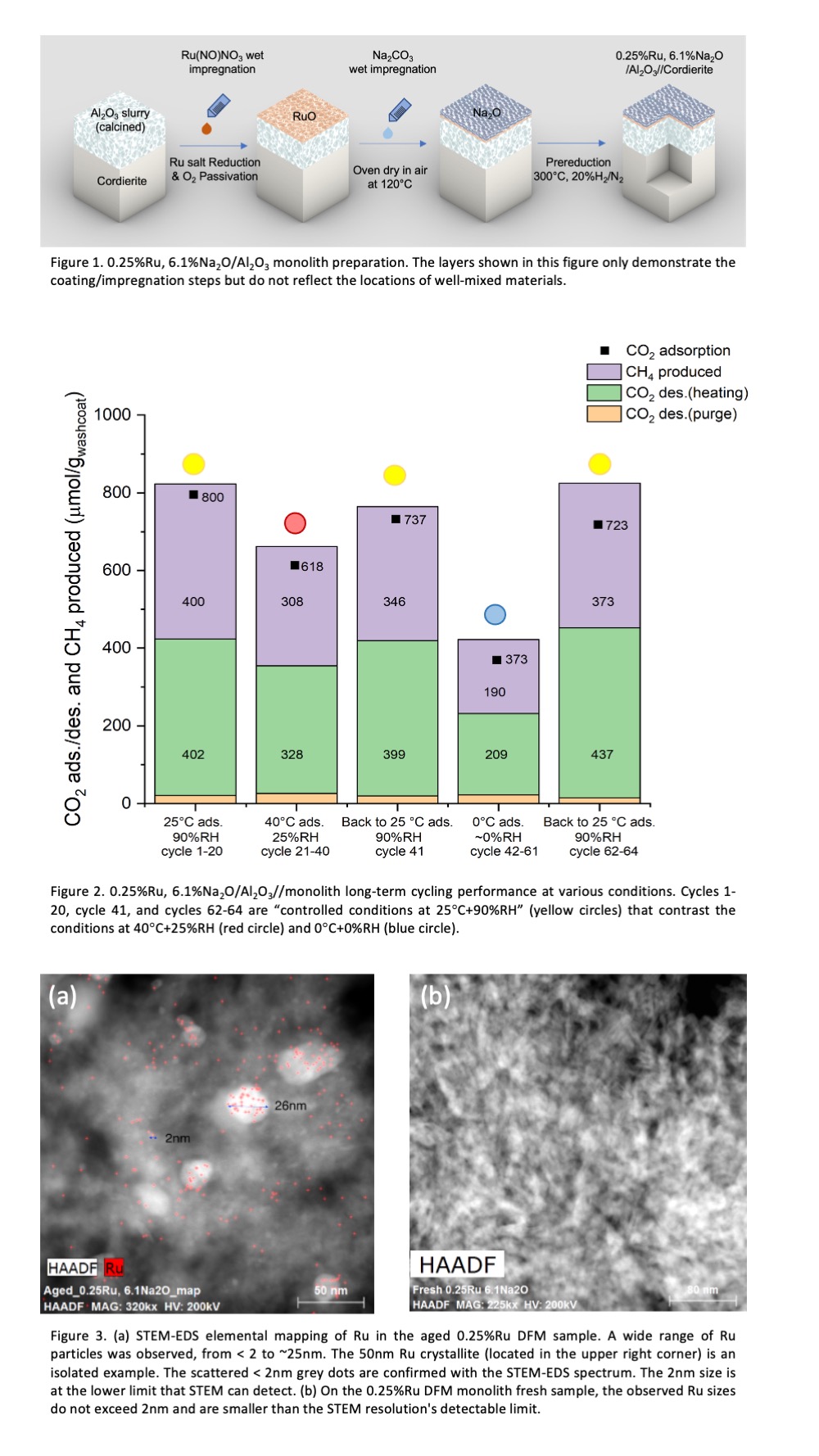
The technology readiness of DFM is very competitive compared to other DAC technologies. Applying DFM on monolithic substrates (supports used in catalytic converters) has been verified with a lower pressure drop than using particle structures in a packed bed. The presented low Ru alkaline DFM's stable performance would significantly decrease the overall capital cost and give more potential to a large-scale direct air capture and methanation (DACM) application, based on the current price of Ru of $16.4/g (April 2023).
Ru crystallite size before and after aging is essential in relating its role in performance changes. Often in other catalytic systems, an increased catalyst size would cause impaired catalytic activity. For the first time, the Ru crystallites with a wide size range from < 2nm to ~25nm were observed by using STEM-EDS elemental mapping, and the increased Ru crystallite sizes after aging showed no decreased catalytic activity.