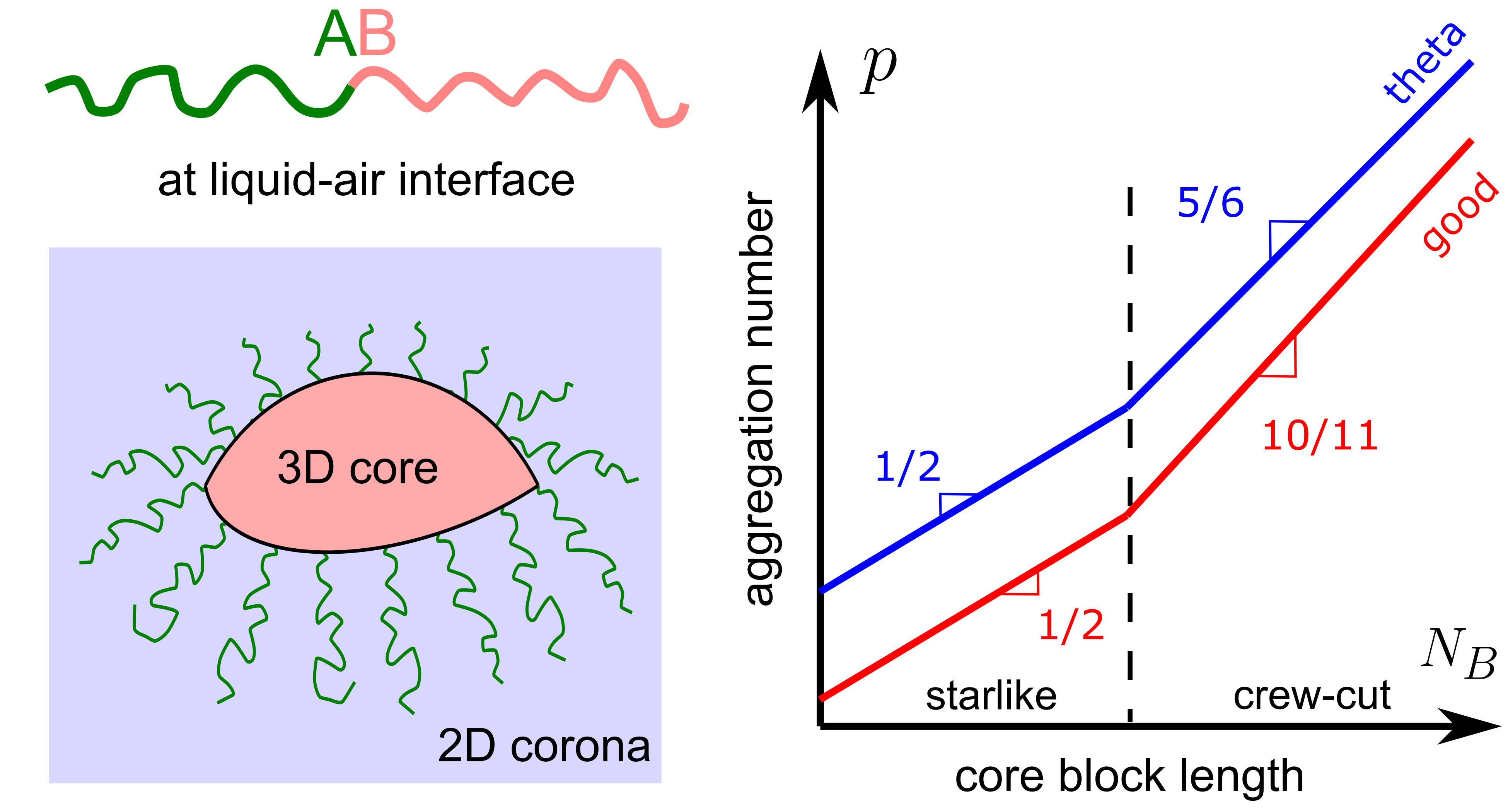
Self-assembly of AB diblock copolymers at liquid-air interfaces is considered theoretically within the scaling approach. Blocks A are adsorbed and swollen at the air-liquid interface. Aggregation of insoluble B blocks results in the formation of the surface micelles with 3D albeit non-spherical core and flat, effectively 2D corona. A theory of circular spherical micelles is developed to predict how their size and the aggregation number, p, depend on the block lengths of the diblock copolymer, N
A and N
B. Scaling laws are derived for the so-called starlike (st) and crew-cut (cc) micelles, which correspond to the limits of small/large core size as compared to the corona thickness. When solvent quality is Î for corona chains, theory predicts p
st ~ N
A0 N
B0.5 and p
cc ~ N
A-0.67 N
B0.83 for starlike and crew-cut micelles, respectively. Theoretical exponents are in good agreement with the scaling laws found in the recent experiments, p ~ N
A-0.48 N
B0.7. [Kim and Kim;
J. Phys. Chem. Lett. 2022, p. 5380] The empirical exponents, which were obtained by numerical fitting experimental data with the
single power law, fall within the range theoretically predicted herein. A similar agreement takes place for the core radius and corona thickness and holds in the case of athermal solvent for the corona A blocks. The developed theory reveals principles of diblock copolymer self-assembly in confined geometries.