2023 AIChE Annual Meeting
(349b) Engineering the Polymer-MOF Interface in Microporous Composites to Address Complex Mixture Separations
Authors
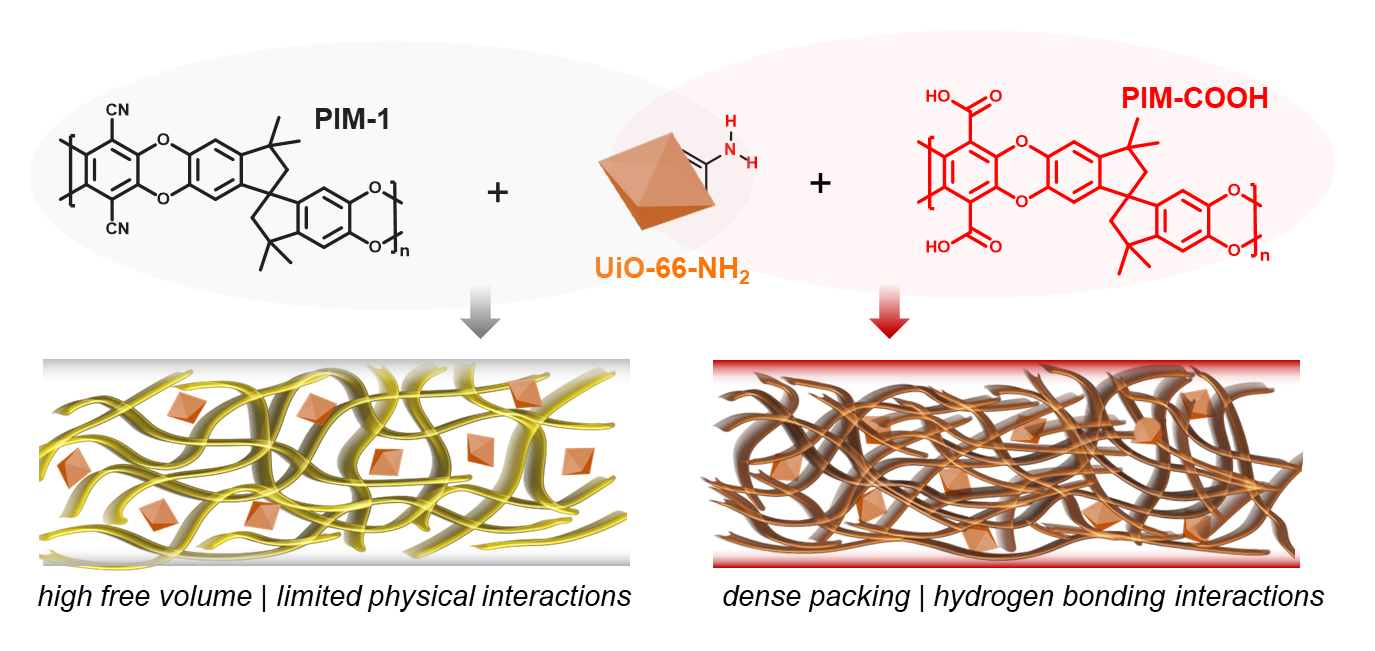
Through replicate film-formation and pure-gas permeation tests, lower sample-to-sample variation was found in MMMs with improved interfacial compatibility. Sorptionâdiffusion analysis revealed that MOF incorporation increases pure-gas diffusion, while the sorption coefficient remains relatively constant, suggesting that the highly porous MOF significantly reduces activation energies of diffusion for molecules that are smaller than the MOF pore aperture. Furthermore, incorporation of MOF in PIM-COOH mitigates CO2- and H2S-induced plasticization effects compared to PIM-1 MMMs.
The effects of MOF incorporation on mixed-gas transport in MMMs were probed through CO2/CH4, CO2/N2, and H2S/CO2/CH4 tests. Increased CO2-based mixed-gas selectivities were observed for all samples, regardless of MOF addition. In H2S/CO2/CH4 mixtures, all films demonstrated significant competitive sorption effects with H2S and higher H2S/CH4 mixed-gas selectivities and lower CO2/CH4 selectivities compared to the pure gas case. Notably, the highest H2S/CH4 and CO2/CH4 selectivity combinations were found for the PIM-COOH-based MMM due to increased polymer inter-chain rigidity provided by the MOF. This study demonstrated the strategy of tuning MOF and polymer composition to improve interfacial compatibility and highlights the importance of testing new membrane formulations in industrially-relevant mixtures.