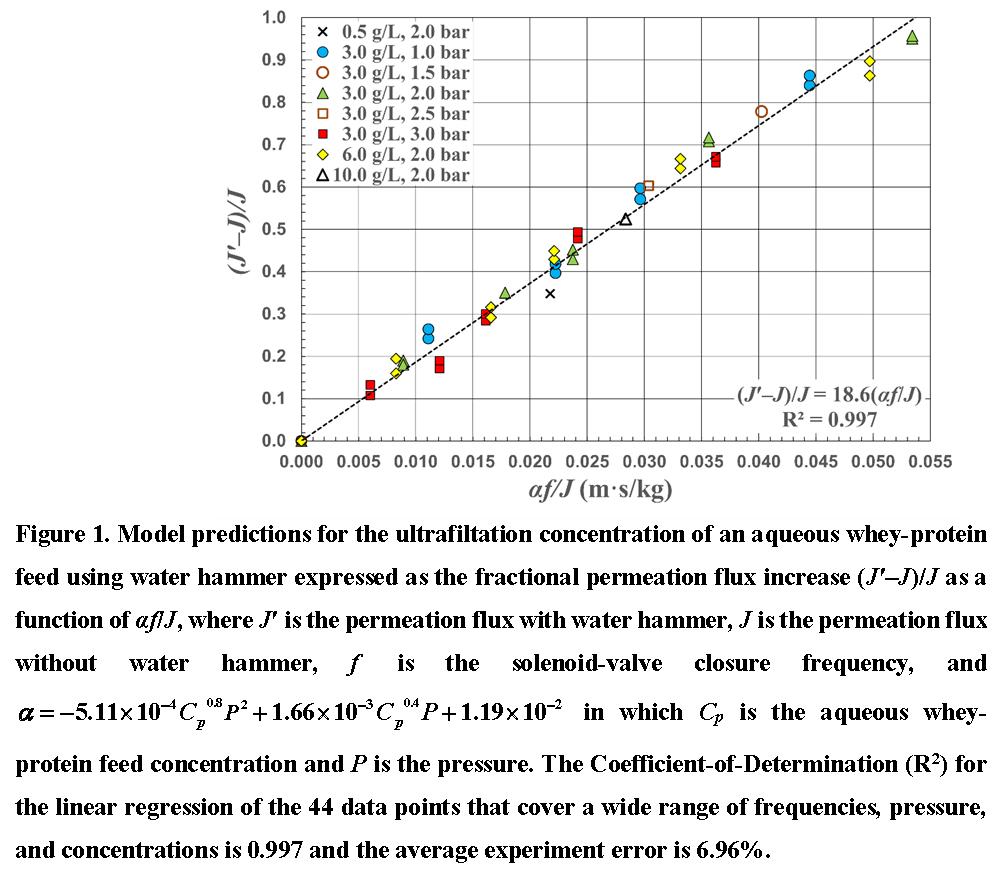
Fouling is an endemic problem in ultrafiltration as well as other membrane separation and concentration processes. Recently water-hammer pulsing has been shown to reduce membrane fouling in both ultrafiltration and reverse osmosis [1,2,3,4]. Rapid solenoid-valve closure on the retentate or permeate side of a membrane generates a pressure front that propagates and reflects at the system boundaries at the speed-of-sound in the system. However, the mechanism whereby this mitigation occurs is not well-understood; as such, a predictive model is lacking to permit scaleup of this process. In this paper a mathematical model is advanced for mitigating fouling using pulsed solenoid-valve closure in the ultrafiltration of particulates. The model assumes the boundary-layer flow that develops after the first pressure-front reflection at the upstream boundary causes a significantly enhanced shear stress on the fouled membrane. This increased shear stress typically occurs for less than one-hundredth of a second during each solenoid-valve closure that occurs once every several seconds. However, it has a significant effect on removing the fouling deposits because it is orders-of-magnitude larger than the shear stress of the steady state crossflow velocity. Figure 1 shows a plot of the fractional permeation flux increase for 44 experiments as a function of a dimensionless group that incorporates the range of fluxes, foulant concentrations, pressures, and solenoid-valve-closure frequencies for concentrating an aqueous whey-protein feed. The average experiment error is 6.96% and the Coefficient-of-Determination for the model fit to these 44 data is 0.997. The fractional permeation flux increase ranged between 10.7% and 124% with an average increase of 51.2%. However, the model indicates that higher fractional permeation flux increases are possible if a solenoid valve is used that can be pulsed at higher frequencies.
[1] F. Broens, D. Menne, I. Pothof, B. Blankert, H.D.W. Roesink, H. Futselaar, R.G.H. Lammertink, M. Wessling, Water hammer reduces fouling during natural water ultrafiltration, Water Res. 46(4) (2012) 1113â1120.
[2] B. Liberman, L. Eshed, G. Greenberg, Pulse Flow RO - The new RO technology for waste and brackish water applications, Desalination 479 (2020) 114336.
[3] M. Aslam, F. Wicaksana, M. Farid, A. Wong, W.B. Krantz, Mitigation of membrane fouling by whey protein via water hammer, J. Membr. Sci. 642 (2022) 119967.
[4] W.B. Krantz, F. Wicaksana, M. Aslam, A. Wong, M.Farid, Development and validation of a model for mitigating particulate fouling in ultrafiltration using water-hammer, J. Membr. Sci. 666 (2023) 121098.