H
2O and CO affect the NO
x adsorption/desorption characteristics of Pd/CHA passive NO
x adsorbers. However, the presence of various Pd sites (Pd
2+, Pd
1+, [PdOH]
+, and [Pd-O-Pd]
2+) makes it challenging to decipher their role on the NO
x adsorption-desorption cycle. DFT calculations are performed in this work to understand the impact of H
2O and CO on NO interaction with various Pd sites, and explain the mechanisms of NO adsorption, oxidation, and desorption in their presence. Calculations show that while H
2O has a negligible effect on the NO adsorption energetics for various Pd sites (Pd
2+, Pd
1+, and [Pd-O-Pd]
2+), it significantly weakens the NO binding on [PdOH]
+. However, the presence of CO on a [PdOH]
+ site with pre-adsorbed H
2O strengthens NO binding. Even though the presence of H
2O facilitates the reduction of [PdOH]
+ and [Pd-O-Pd]
2+ by NO, it negatively impacts the desorption of NO
2 (formed by NO oxidation) from the Pd
1+ sites. In addition, CO is shown to be a better reductant as compared to NO when both CO and NO are co-adsorbed on [Pd-O-Pd]
2+, thus resulting in the formation of Pd
1+. The Pd
1+ sites can reoxidize to Pd
II species under an oxidizing atmosphere, such that the NO desorption is facilitated. However, in the presence of H
2O, NO oxidation is favored over Pd
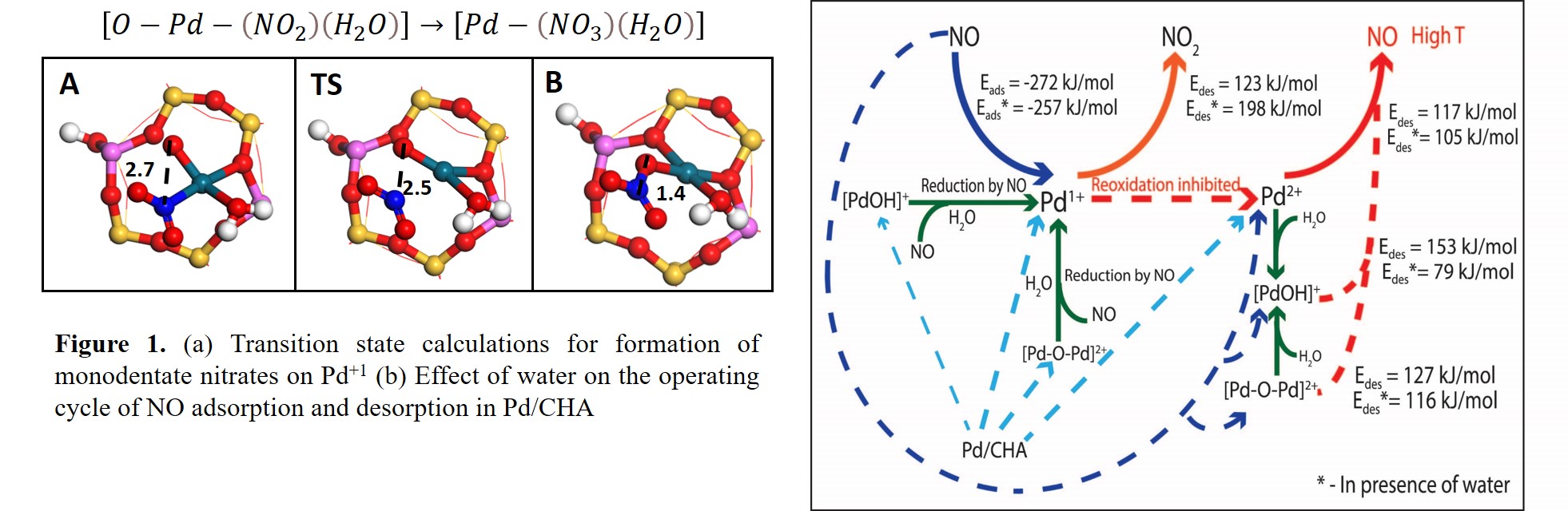
1+ reoxidation, thus resulting in the formation of monodentate nitrates (Figure 1(a)). The monodentate nitrates transform to the more stable bidentate nitrates upon water desorption. This finding, along with the higher NO
2 desorption energy in the presence of H
2O can explain the increase in the NO
x desorption temperature in the presence of H
2O. The proposed effect of H
2O on the NO
x operating cycle is depicted in Figure 1(b). In the full paper, the inferences obtained on the effect of H
2O and CO will be used to explain the reported experimental data.