2022 Annual Meeting
(378f) Mechanistic Details of the Selective Deoxygenation of Pentanoic Acid Using Molybdenum Oxide as a Catalyst: The Complex Role of the Local Hydrogen Concentration
Authors
Laura A. Gomez - Presenter, university of Oklahoma
Steven Crossley, University of Oklahoma
Caleb Bavlnka, University of Oklahoma
Ethan Zhang, University of Oklahoma
Bin Wang, University of Oklahoma
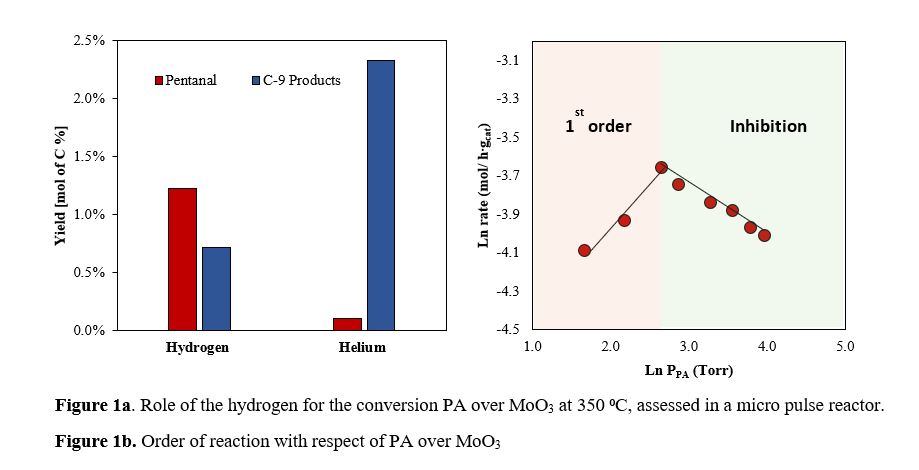
Carboxylic acids represent a significant fraction of renewable chemicals derived from lignocellulose biomass. While it is known that reduced metals are capable of facilitating complete deoxygenation to form alkanes, oxides such as MoO3 have recently shown the potential to selectively activate acids to yield aldehydes and alcohols. This is quite promising, paving the way for commodity chemical synthesis. Here, we evaluate the kinetics of pentanoic acid (PA) to yield aldehydes over MoO3 in a gas-phase reactor. We show that incorporating low loadings of Pt clusters increases the conversion rate of PA by promoting H2 dissociation, shifting the RDS from oxygen vacancy creation/regeneration to hydrogen addition to the carbonyl group. To achieve more insight into the mechanism, a micro pulse reactor was used to decouple the role of local H2 coverage on the overall reaction. Figure 1a shows that pentanal (PAL) production is favored only in the presence of H2, which indicates that this form of redox chemistry is not a simple Mars van Krevelen mechanism, and hydrogen coverage is a residual requirement for this chemistry to occur. DFT calculations allow contrasting the various adsorption modes of PA, revealing the presence of a strongly bound spectator species, which limits H2 dissociation and spillover rates. The consequences of these spectator species are illustrated by a negative reaction order at a high partial pressure of PA, as shown in Figure 1b, which is even more pronounced with co-feeding water. We also discuss the mechanism, the kinetically relevant steps for deoxygenation over MoO3, the formation of a metastable hydrogen bronze (HXMoO3), and the effect of the incorporation of Pt clusters on the overall process. The hydrogen spillover effect was also studied by separating the Pt at a controlled distance away from the MoO3 on opposing ends of carbon nanotubes.