2022 Annual Meeting
(339d) Atomic Layer Deposited Dual-Function Materials for Combined Adsorption and Oxidation of VOCs
Authors
Fateme Rezaei - Presenter, Missouri S&T
Busuyi Adebayo, Missouri University of Science & Technol
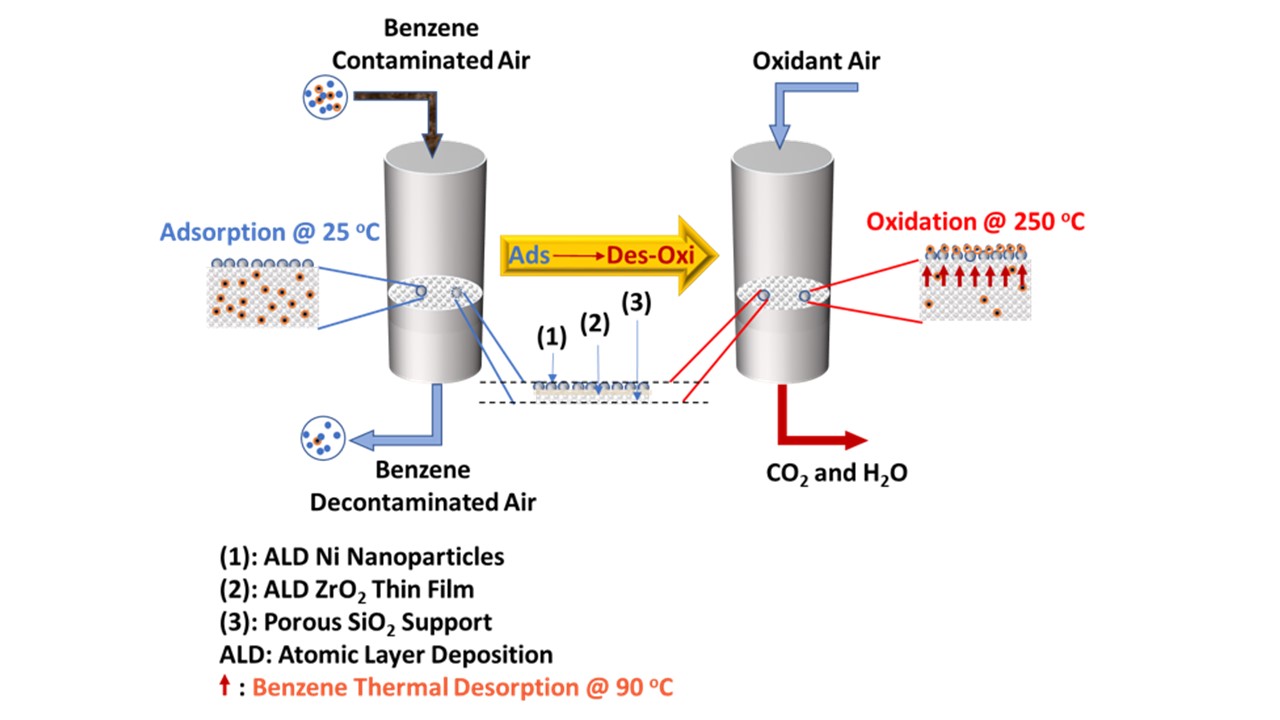
Concentrating ppm-level VOCs in-situ, before their oxidation, offers a practical approach to reduce the catalyst inventory and capital cost associated with VOC emissions abatement. This work reports on the development of novel Ni nanoparticles-deposited mixed-metal oxides ZrO2-SiO2 through atomic layer deposition (ALD) method and their application in combined capture and oxidation of benzene, as a model compound of aromatic VOCs. The benzene vapor adsorption isotherms were measured at 25 ºC and in the pressure range of 0 to benzene saturation vapor pressure thereof (0.13 bar). In the combined capture-reaction tests, the materials were first exposed to ca. 86100 ppmv benzene vapor at 25 ºC, followed by desorption and catalytic oxidation while raising bed temperature to 250 ºC. The textural properties revealed that ALD of Ni or ZrO2 on SiO2 decreased surface area and pore volume, while sequential doping with ZrO2 and then Ni caused the otherwise. The benzene vapor adsorption isotherms followed the type-IV isotherm classification, revealing a combination of monolayer-multilayer and capillary condensation adsorption mechanisms in sequence. At saturation vapor pressure, an average equilibrium adsorption capacity of 15 mmol/g was obtained across the materials. However, the dynamic adsorption capacities were up to 50% less than the corresponding equilibrium uptake for the materials. Benzene desorption temperature was observed around 90 ºC, and conversion of 85-95% and TOF of 1.28-16.42 mmolC6H6/molNi/s were obtained over the materials, with 3Ni/ZrO2-SiO2, prepared with 3 ALD cycles, exhibiting the maximum conversion and TOF indicating synergistic effects of Ni nanoparticles and ZrO2 support based on the number of ALD cycles. However, the yields of CO2 and H2O were about 5% and 40%, respectively. The small value of the CO2 yield was hypothesized to be due to simultaneous high-temperature adsorption of CO2 as the catalytic reaction progressed. In conclusion, the high adsorption affinity, low desorption temperature, and high catalytic activity of the materials investigated in this study made them worthwhile for the abatement of BTX. Specifically, we made bold that the 3Ni/ZrO2-SiO2 material stands to be one of the best dual-functional materials for the abatement of BTX.
Reference
Adebayo, et al., ACS Appl. Mater. Interfaces2020, 12, 35, 39318â39334.