2022 Annual Meeting
(243b) Leveraging Polymer Glass Transition to Access Thermally-Switchable Dense Suspensions
Authors
Juan J. de Pablo, University of Chicago
Michael van der Naald, University of Chicago
Neil Dolinski, University of Chicago
Grayson L. Jackson, University of Chicago
Heinrich M. Jaeger, The University of Chicago
Stuart J. Rowan, University of Chicago
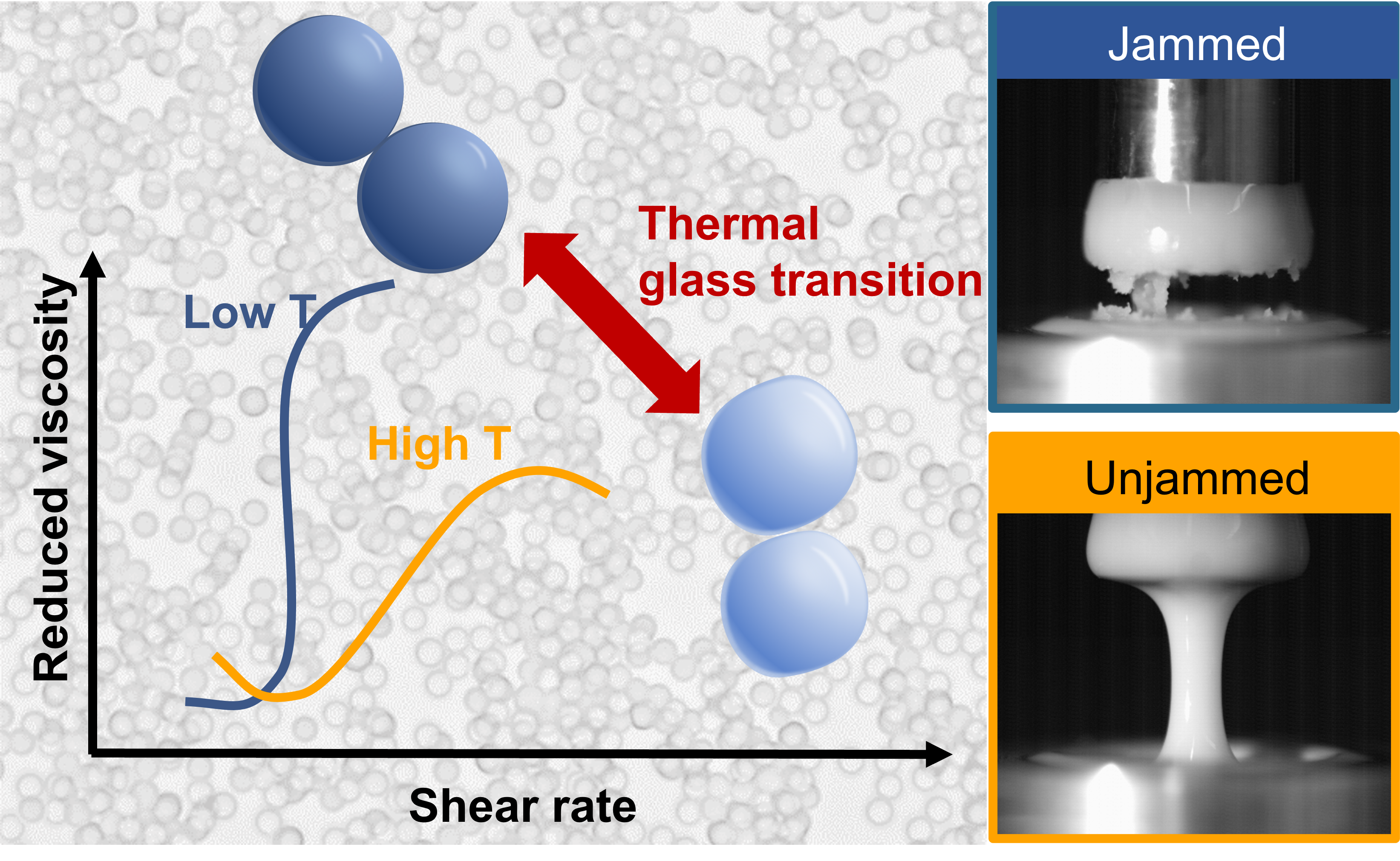
When sheared sufficiently strongly, suspensions having a large volume fraction of solid particles can exhibit a dramatic increase in viscosity (shear thickening) and even solidify (shear jamming). The dramatic shear thickening is undesirable in suspension processing, yet it can also be leveraged in a range of applications, including personal protective wear and damping systems. While recent works have shown that the rheology of dense suspensions is tunable with the microscopic properties of the particles such as roughness and surface chemistry, investigations to date have almost exclusively focused on rigid, non-responsive particles, which do not allow in situ tuning of shear thickening or jamming. In this work, we have developed a strategy for tunning the stiffness in situ by designing and utilizing polymeric particles with accessible glass transition temperatures (Tg). Around Tg, the elastic modulus of particles depends strongly on temperature and changes by ~3 orders of magnitude. We demonstrate that transitioning through Tg of polymer particles has a dramatic and non-monotonic effect on shear thickening and the shear jamming transition can be turned on or off in situ by varying the temperature relative to Tg. This behavior is attributed to the significant change in mechanical stiffness as well as the inter-particle surface friction near Tg. This study lays the groundwork for switchable jamming systems and motivates further research to investigate how polymer dynamics at the interface can affect the constraints on particle relative motions.