2020 Virtual AIChE Annual Meeting
(738h) A Mechanism Study of Roles of Water in Acetone-to-Isobutene Reaction over the Balanced Lewis Acid-Base Pairs
Authors
Houqian Li - Presenter, Washington State University
Junming Sun, Washington State University
Nicholas Jaegers, Pacific Northwest National Laboratory
Jean-Sabin McEwen, Washington State University
Nisa Ulumuddin, Washington State University
Yong Wang, Washington State University
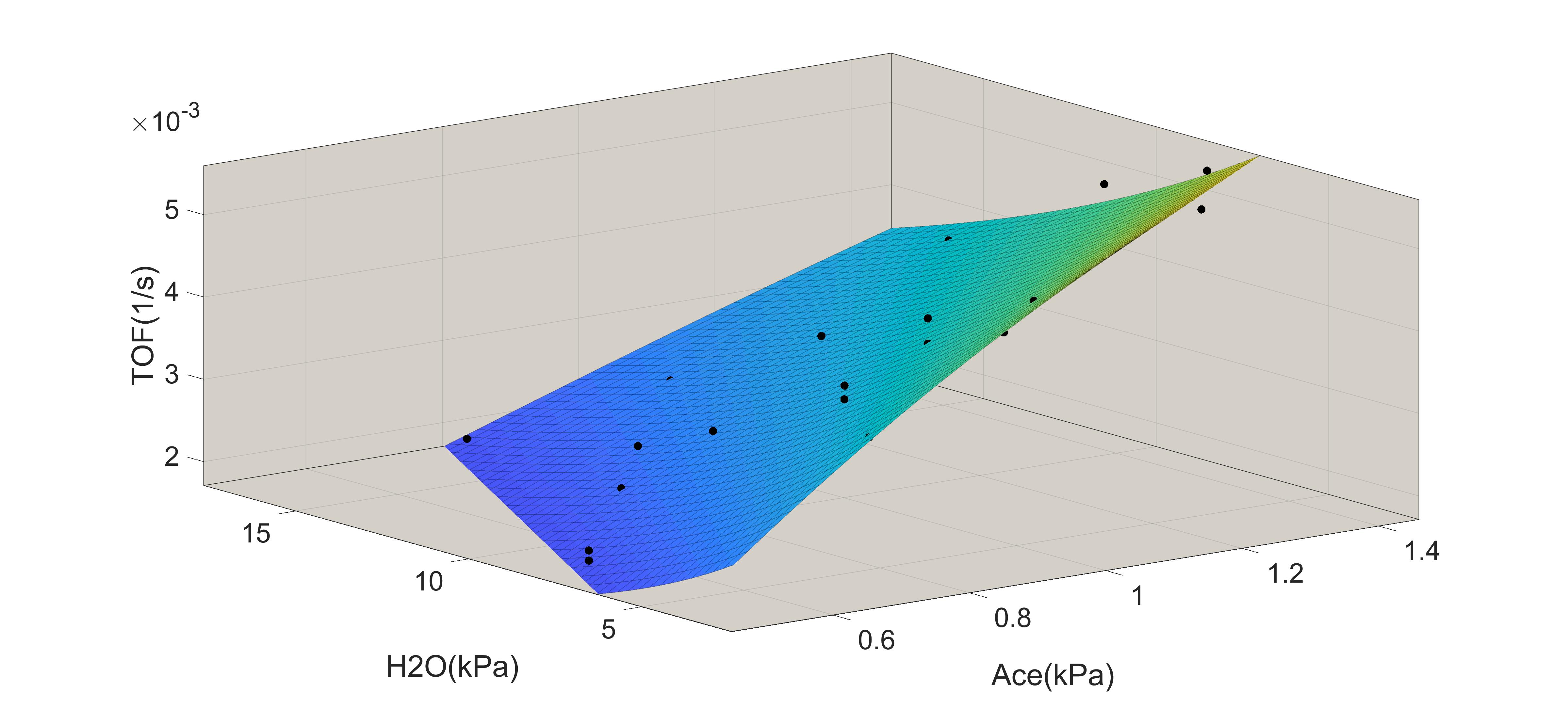
Aldol-condensation of acetone has been practiced in both industry and academia to produce variety of valuable chemicals [1]. Recently, we reported ZnxZryOz with balanced Lewis acid-base pairs catalyzes a cascade ethanol-to-isobutene reaction in the presence of water which is limited by acetone-to-isobutene (ATIB) [2]. ATIB conversion has been extensively studied over zeolites with Brønsted acid sites, and an aldolization (to form mesityl oxide/MSO) followed by cracking (of MSO) reaction mechanism has been widely accepted [3]. However, the mechanism of this reaction catalyzed by Lewis acid-base pairs and roles of water remain elusive. Here, we combine kinetics, in situ DRIFTS, 1H-NMR, isotopic labeling, as well as DFT studies to elucidate the roles of water and reaction mechanism. Appropriate amount of framework Zn2+ in ZrO2 can generate balanced Lewis acid-base pairs over ZnxZryOz [2]. No Brønsted acidity was detected even at elevated temperatures and in the presence of water, evidenced by in situ 1H-NMR and DRIFTS-Py results. A comparison of DAA reaction in the presence/absence of water reveals that co-fed water largely inhibits the DAA dehydration for MSO, which rapidly deactivates the catalyst. Acetone-H218O isotopic studies suggest that ATIB mainly goes through the DAA intermediate without involving surface OH in the catalytic cycle. The parity plot shows that rate equation derived from this mechanism could accurately describes the rate we measured. Co-feeding water is proposed to occupy the Lewis acid sites, which in turn inhibits the dehydration of generated surface DAA. Instead, the adsorbed DAA form a 8-member ring transition state, which was directly rearranged to form IB and surface acetate.
References:
- Salvapati, G. S et al., J.Mol.Catal. 54,9-30(1989).
- Sun, J. M. et al., JACS. 138,507(2016).
- Herrmann, S.; Iglesia, E. J.Catal. 360,66-80(2018)