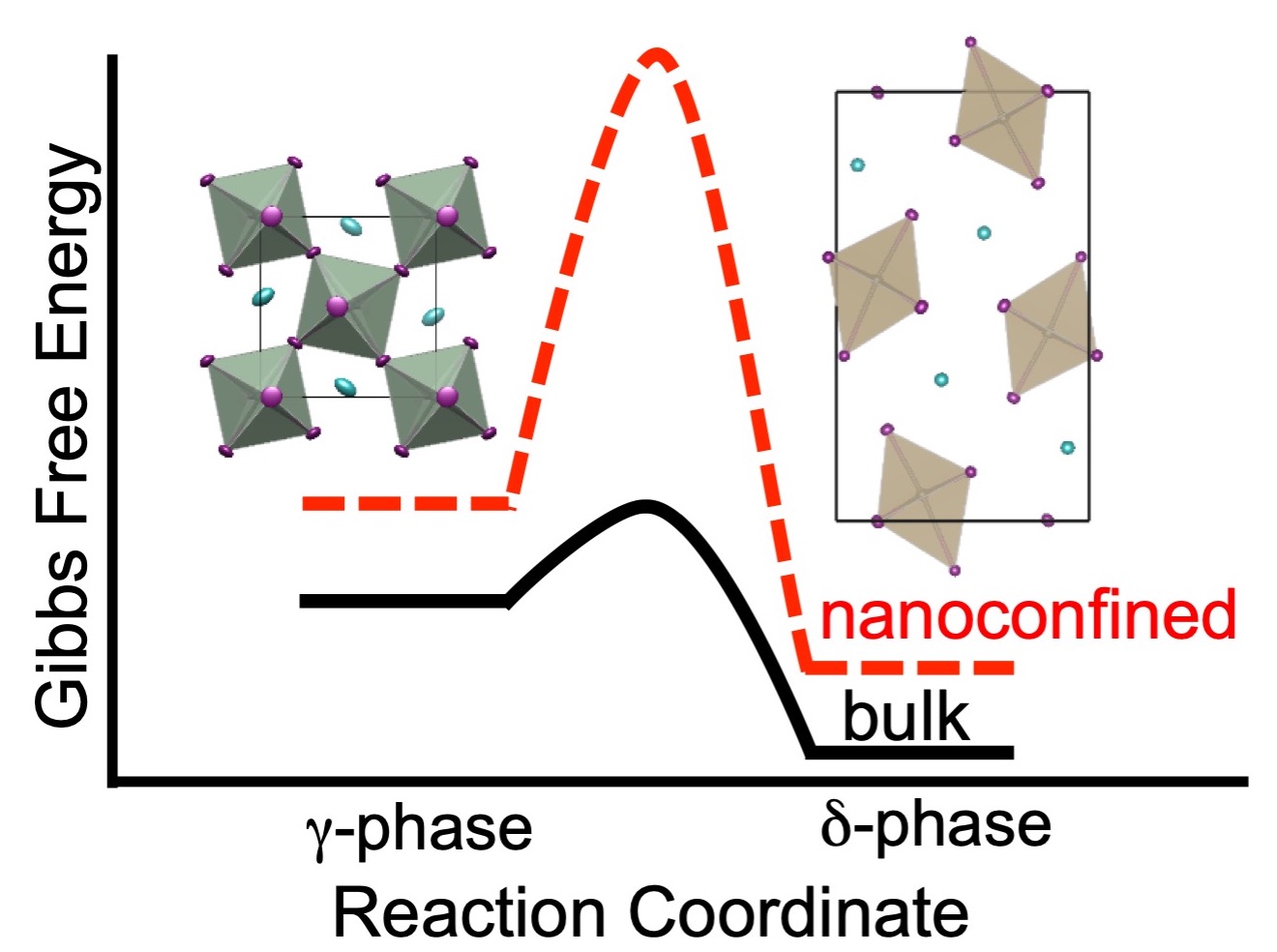
Metal-halide perovskites have emerged as frontrunners in the field of emerging solution-processable photovoltaics, with solar conversion efficiencies of MHP-based solar cells recently exceeding 25%. A critical obstacle facing the commercialization of these compounds is their sensitivity to humidity-induced degradation and temperature-induced polymorph transitions. In this work, we present nanoconfinement as a generalizable strategy to impart unprecedented air and thermal stability to MHPs. Specifically, MHPs, including MAPbI
3 and CsPbI
3, were crystallized in the cylindrical nanopores of anodized aluminum oxide templates and their properties studied via x-ray diffraction, temperature-dependent photoluminescence spectroscopy, and low-frequency Raman spectroscopy. We discovered that nanoconfinement affects the relative Gibbs free energies of solid-state polymorphs by increasing the surface free energy contribution to the total Gibbs free energy compared to the volume free energy contribution [1,2]. By shifting thermodynamic phase transition temperatures and kinetically trapping crystals within nanoconfined environments, the active phase of CsPbI
3 was stabilized to temperatures as low as 4 K, enabling the extraction of longitudinal optical phonon energies through temperature-dependent photoluminescent experiments [1]. The stability of nanoconfined MHPs upon storage in air was also dramatically improved, with no degradation observed after at least 2 years [3,4]. Most recently, we combined the use of nanoconfinement and a below bandgap 976 nm laser source to study phonon modes in stabilized MHPs via low-frequency Raman spectroscopy measurements. Through systematic replacement of I
- with Br
- or Cs
+ with methylammonium (MA
+) in nanoconfined CsPbI
3 crystals, we discovered that the energy of these phonon modes depends primarily on the lattice dimensions, not the identity of the ions themselves. Given that electron-phonon coupling is thought to be a limiting factor in the optoelectronic performance of metal-halide perovskite active layer, an accurate understanding of the nature of these interactions is critical.
- Kong, X., Shayan, K., Hua, S., Strauf, S., and Lee, S. S. âComplete Suppression of Detrimental Polymorph Transitions in All-Inorganic Perovskites via Nanoconfinementâ ACS Applied Energy Materials 2, (2019): 2948â2955.
- Kong, X., Zong, K., and Lee, S. S. âNanoconfining Optoelectronic Materials for Enhanced Performance and Stabilityâ Chemistry of Materials 31, (2019): 4953â4970.
- Lee, S., Feldman, J., and Lee, S. S. âNanoconfined Crystallization of MAPbI3 to Probe Crystal Evolution and Stabilityâ Crystal Growth & Design 16, (2016): 4744â4751.
- Kong, X., Shayan, K., Lee, S., Ribeiro, C., Strauf, S., and Lee, S. S. âRemarkable Long-Term Stability of Nanoconfined Metal-Halide Perovskite Crystals against Degradation and Polymorph Transitionsâ Nanoscale 10, (2018): 8320â8328.