2020 Virtual AIChE Annual Meeting
(557d) Surface Area Determination of Kevlar® Particles in Suspensions Containing Iron Impurities Using Low-Field Nuclear Magnetic Resonance Relaxometry
Authors
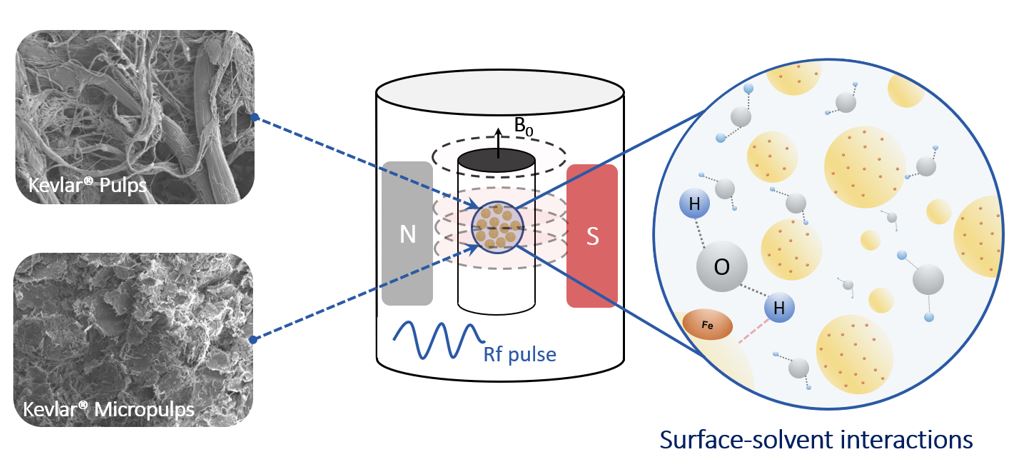
The six different Kevlar® particles used in the experiments were divided into two main categories according to their particle sizes: pulps and micropulps. The latter species is obtained via size reduction of pulps. In their characterization, scanning electron microscopy (SEM) elucidated morphological differences, highlighting structural changes of Kevlar® pulps as they are milled to obtain the micropulps. Subsequently, BET gas adsorption was utilized to assess the specific surface area of samplesdried at either high or cryogenic (lyophilization) temperatures. The specific surface area of Kevlar® pulps was found to increase by as large as a factor of three when particle size was reduced by milling pulp materials (7 â 17 m2 g-1) to micropulps (20 â 24 m2 g-1). Furthermore, signs of particle collapse were observed, as the lyophilized samples presented a higher specific surface area than the vacuum dried ones. Based on the noticeable differences in the SEM and BET results, Kevlar® samples were suspended in deionized water and analyzed using a NMR benchtop instrument, with a magnetic field of 0.47 T and a radio frequency of 20 MHz. Initially, the NMR relaxation rates were assumed to be strictly related to the wetted surface areas but to ensure the samples were uniform in composition, further investigation was done. Inductively coupled plasma optical emission spectroscopy (ICP-MS) indicated the presence of trace iron varying in the range 11 - 2,633 ppm. In systems with paramagnetic impurities such as iron or manganese, the relaxation rate of the fluid will be enhanced via electron-proton coupling and may dominate the signal. To address the influence of iron, the surface relaxivity of Kevlar®, was determined as 0.7 µm s-1 based on a linear relationship between the iron content and its perturbation of the transverse relaxation time T2 of the system. Lastly, the wetted specific surface area was calculated from the NMR data, where values in good agreement with those obtained from the BET analysis of lyophilized samples were found. The trends related to the foreseen effects of polymer drying and particle size reduction were also present. It is envisioned that the present method can be expanded to a large set of polymer chemistries and could enable high-throughput wetted surface area measurements. The ability to accomplish complete analyses within a much shorter time than the BET method is also an attractive feature over conventional methodology.