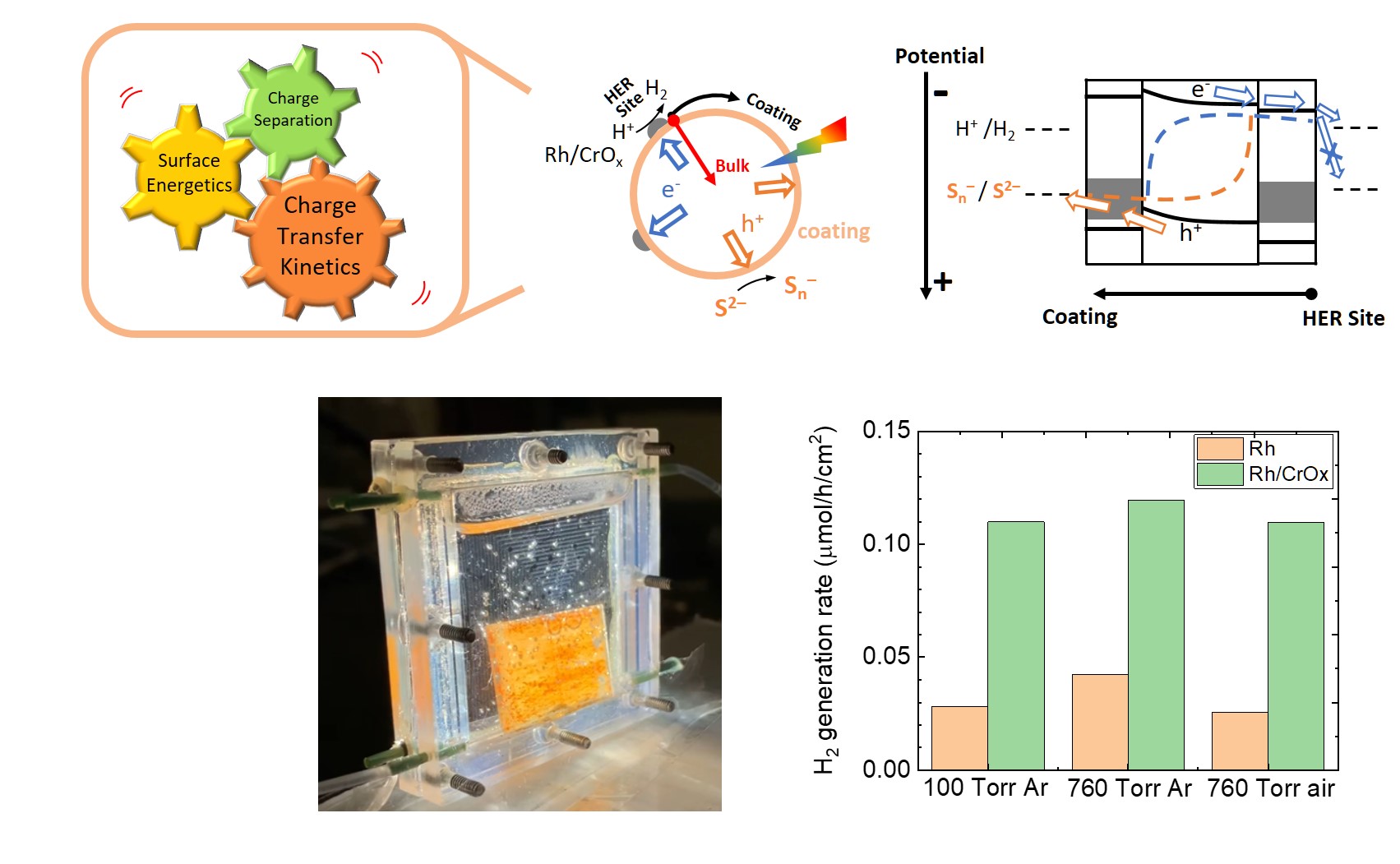
Photocatalytic nanoparticles that are suspended in water or sprayed onto a panel promise solar-to-fuel energy conversion at scale. The fabrication processes for these photocatalysts to achieve efficient energy conversion should be simpler than solar cells and photoelectrodes. However, the design principles for reaching their performance limit are still elusive. We use few-nanometer thin stabilization coatings to enable an entire class of otherwise unstable particulate semiconductors for coevolution photocatalysis. CdS particles that are sprayed into a film and stabilized with an ALD coating coevolve H
2 at a record rate of 48.5 mmolâh
-1âg
-1 or 2.5 mL H
2âh
-1âcm
-2 under 1-sun solar illumination in ambient air. Moreover, we demonstrate a redox-mediated particulate reactor that separates the H
2 and O
2 products, which is safe. We systematically advance towards the solar-to-fuel efficiency limit of for photocatalysts, instead of trial-and-error that is often practiced in this field. To justify our approach, we will discuss the holistic understanding for the photophysical, electrocatalytic, and transport processes that are coupled at the nanoscale.