2020 Virtual AIChE Annual Meeting
(344w) Development of Mesopore-Containing CON-Type Zeolite with Unique Acidic and Catalytic Properties
Authors
[Al,B]-CON was prepared by following the composition and procedure reported by S. Park et al. [3]. For the alkaline-treatment, [Al,B]-CON (H-form) was added into the NH4OH solution (1.1 or 2.2 mol Lâ1) containing CTABr (0.03 mol Lâ1). The obtained samples were designated as [Al,B]-CON_x, where x represents the NH4OH concentration used for the alkaline treatment.
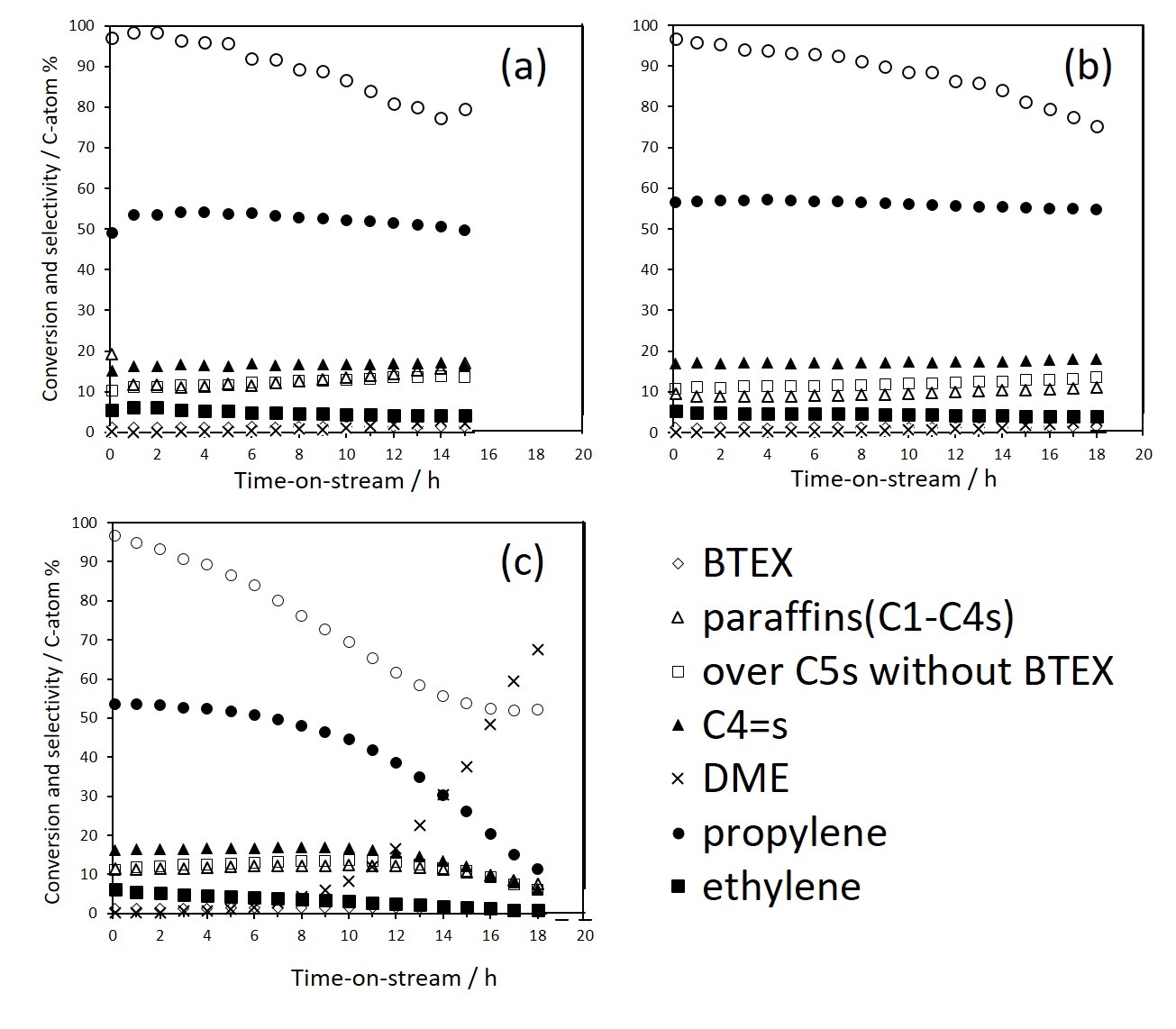
XRD peak patterns of samples indicate that the CON structure has retained after the alkaline-treatment. The number of acid sites were comparable before and after the alkaline-treatment but the mesopore volume increased at the expense of the micropore volume. We could confirm the incorporation of mesopores by TEM and N2 adsorption analyses. in-situ FT-IR spectra after the 2,4,6-trimethylpyridine adsorption indicated the enhanced diffusion properties of the sample through the alkaline-treatment. In MTO reaction [Al,B]-CON_1.1 showed the enhanced catalytic life with the higher propylene selectivity (Fig. 1) which could be attributed to the positive effect of alkaline-treatment on both acidic and diffusion properties of the CON-type material.
[1] J.Y. Ying et al,, US20050239634 (2005).
[2] M. Yoshioka et al., ACS Catal. (2015) 5, 4268â4275
[3] S. Park et al., Microporous Mesoporous Mater. (2020) DOI: https://doi.org/10.1016/j.micromeso.2020.110213