2020 Virtual AIChE Annual Meeting
(30g) Selective Catalytic Hydrogenation of Levulinic Acid over Ru Nanocluster Supported on TiO2 and Titanate Nanotubes
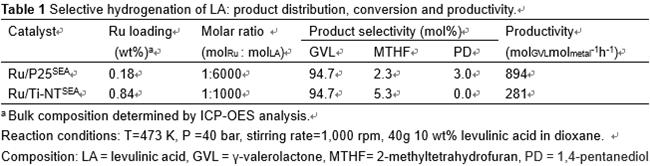
Levulinic acid (LA) is a bio-derived platform feedstock which can be upgraded to γ-valerolactone (GVL) by selective hydrogenation. Ruthenium-based catalysts have received considerable attention for valorization of levulinic acid due to their water and acid tolerance. TiO2 has been widely used as a support for precious metals in the selective hydrogenation of LA to GVL. Titanate nanotubes (Ti-NT) are an attractive support material due to the high surface area compared to TiO2 and the high concentration of surface hydroxyl groups, which can serve as anchoring sites for metal nanoparticles. In this work, Ru nanocluster have been supported on Ti-NT and on P25 TiO2. The Ru nanocluster catalysts have been prepared by strong electrostatic absorption (SEA) and by colloidal synthesis. The selective hydrogenation of LA to GVL has been studied under batch reaction conditions with in-situ catalyst pre-reduction. The catalyst performance proved to be sensitive to the pre-reduction procedures. The most active Ru/Ti-NTSEA catalyst was reduced at high temperature, which has markedly superior catalytic activity compared to catalysts treated by thermal reduction at lower temperature or by chemical reduction with NaBH4. Ru/P25SEA prepared by the same procedure exhibited higher catalytic activity with a productivity of 894 molGVLmolRu-1h-1 and gave deeper hydrogenation. Ru/Ti-NTSEA and Ru/P25SEA maintained a high level of performance with high LA conversion and GVL yield with repeated recycling. The absence of the intermediate 1,4-pentanediol (PD) for the Ti-NT catalysts is probably associated with the surface acidity of the titanate nanotube support. The higher catalytic activity of Ru/P25SEA is likely to be related to the presence of mixed-phase titania. Results from TPR and XPS suggest a strong interaction between Ru and reducible Ti from high temperature reduction. The nature of support material and the pre-reduction conditions strongly influenced the catalytic activity and product distribution in the selective hydrogenation of LA.