CO
2 conversion has been intensively studied in recent years for global environmental and energy issues. Considerable high-performance electrocatalysts have been reported to catalyze CO
2 reduction reactions (CRRs) into different chemicals with renewable electricity. However, CO
2-based CâC coupling reductive reactions with high efficiency and selectivity have not been realized yet. Based on inorganic catalysis, CO and formate are usually obtained from CRRs. Recently, water splitting-biosynthetic hybrid system has been proved to be a promising platform for CO
2 reduction to complex compounds such as isopropanol, terpenes and poly(3-hydroxybutyrate). As a combination of inorganic water splitting system and H
2-oxidizing autotrophic microorganisms, microbial can take energy from H
2 to convert CO
2 to different chemicals, biofuels and medical intermediates with high selectivity. Besides, cellular metabolism can be rewired to the formation of the products of interest further via synthetic biology approaches. In this study,
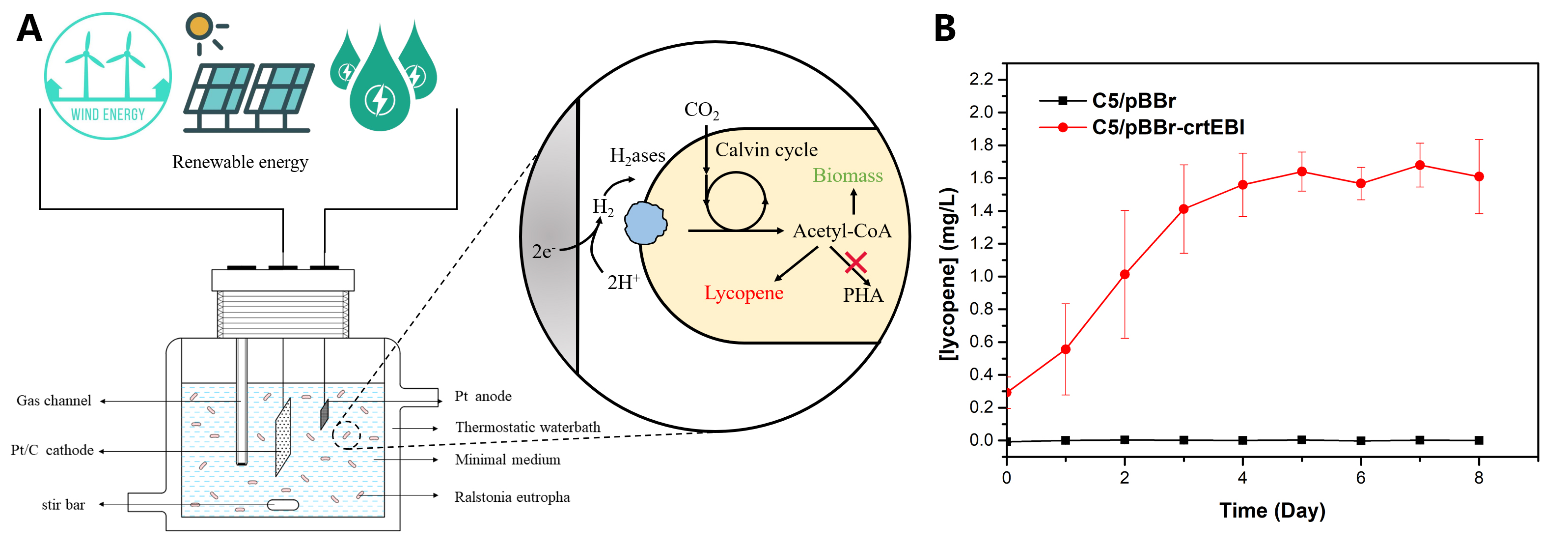
Ralstonia eutropha C5/pBBR1-crtEBI, a recombinant strain that can convert CO
2 to lycopene under autotrophic conditions, was constructed. Then a microbial electrosynthesis (MES) system was established by coupling C5/pBBR1-crtEBI with water splitting system. At a constant current of 18 mA, C5/pBBR1-crtEBI could grow in this system and OD600 increased from 0.3 to 1.17 in 8 days. After systematic optimization of the MES system, the maximum lycopene production reached 1.68 mg/L while no lycopene was detected in the control strain. This system also showed excellent stability, where lycopene can be synthesized continuously for more than 8 days. To the best of our knowledge, for the first time, lycopene can be successfully synthesized in water splittingâbiosynthetic system driven by renewable electricity. This work provides a new idea for CO
2 conversion to complex products simultaneously with storage of renewable energy.